03. Mind and Silicon: Guarding Models, Chips, and Clusters
The Sourdough Starter, the Bakery Window, and the Cast-Iron Oven
To an everyday person typing a question into a phone, artificial intelligence feels like one seamless magic trick: a text box that talks back. To an engineer, and now to export-control writers in Beijing and Washington, an AI system has three distinct physical and digital layers:
- The bakery window (Remote API & apps): Handing a customer a warm slice of bread through a shop window tells them nothing about how to wire the oven or bake ten thousand loaves of their own tomorrow.
- The sourdough starter and master recipe (Weights, checkpoints & training code): Billions or trillions of learned numerical parameters (
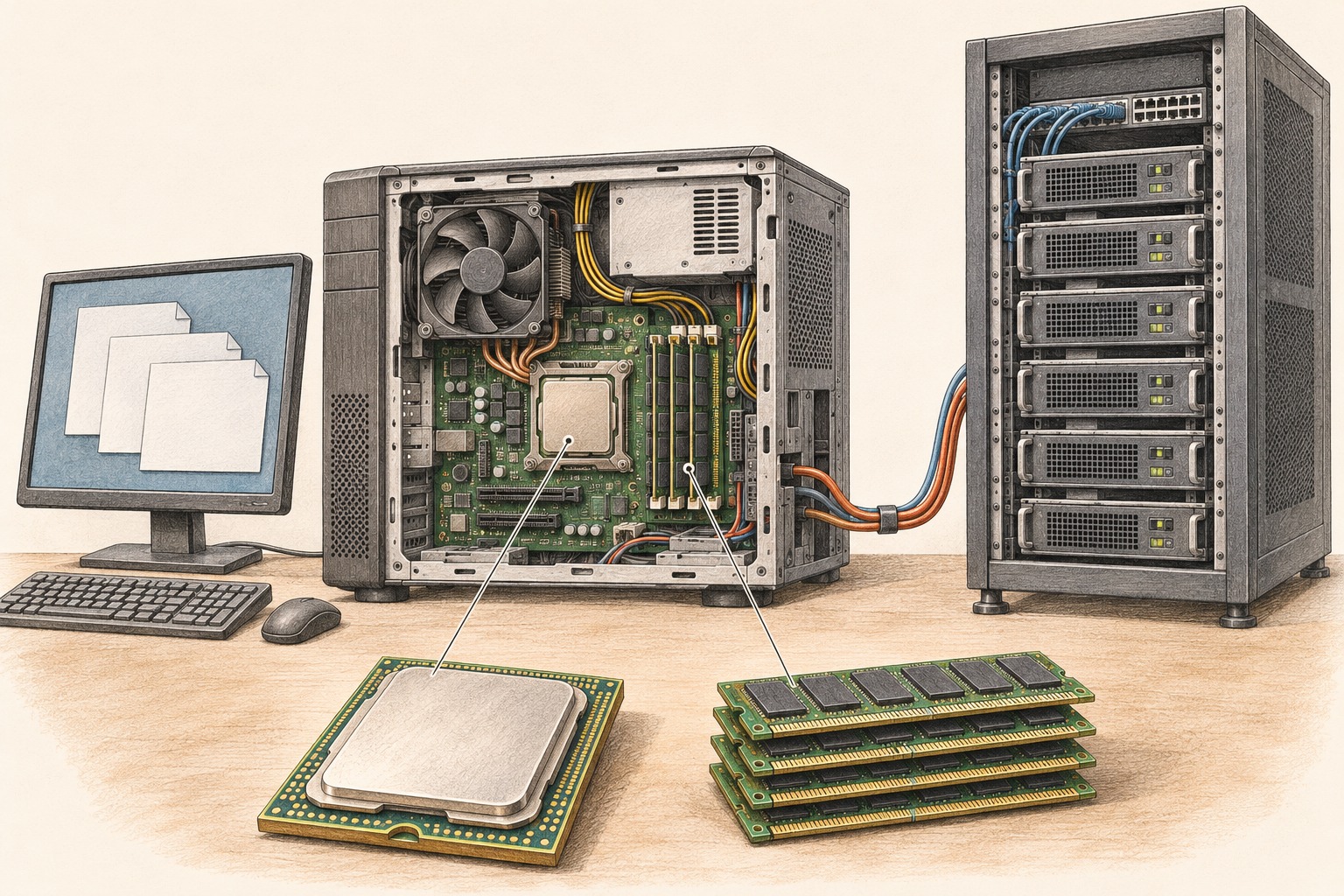
模型权重), intermediate training snapshots (关键检查点), model architecture, and training/inference optimization code (训练优化、推理加速). Copy these files, and you replicate the trained mind itself. - The cast-iron oven and power plant (AI chips, memory stacks & superclusters): The physical silicon processors, high-bandwidth memory, chip blueprints, and optical cluster networks without which neither training nor private local deployment can happen.
MOFCOM's Q&A distinguishes remote API, app, web, SaaS and lightweight local services from transfers of restricted large-model technology under the proposed measures. This is a statement about that scope, not an exemption from every technology or data rule. Attachment 1 separately lists model technology (266504X), processor and memory designs (266506X), and specified technologies for clusters with more than 10,000 accelerator cards (266507X). CNQA CN-A1
Three Tripwires for a Frontier Model (266504X)
Not every neural network trained in a university lab or startup garage crosses into proposed restricted entry 266504X Point 2. A model's core technology (weights, key checkpoints, underlying source code, architecture, training optimization, and inference acceleration) enters scope if it crosses any one of three tripwires CN-A1, 266504X(2), note 3:
- Compute scale: Total training computation reaches at least \(10^{26}\) floating-point operations (FLOPs), the massive compute threshold also used in America's
4E091model-weight rule US25. - Parameter size: Total parameter count reaches at least 2 trillion (2,000 billion).
- Global Top-10 capability at the moment of export: Even a lean, compact model qualifies if, at the time export occurs, public evaluations by mainstream domestic or international benchmark institutions or major industry platforms rank it in the Global Top 10 across overall capability, specialist business tasks, global call volume, safety performance, or training efficiency CN-A1, 266504X, note 3.
That third tripwire is uniquely alive. Because open-source researchers constantly invent clever ways to distil frontier reasoning into 30B or 70B parameters, a compact prodigy can step into restricted scope on the week it debuts at #6 in the world, and step back out eight months later when newer models overtake it. Classification belongs to a specific model version on a specific date, never to a brand name like "DeepSeek" or "Qwen" forever CN-A1.
Data Red Lines (266501J & 266504X(1)) and Autonomous Agents (266505X & 266502J)
Even a small model hits a hard wall if trained on sovereign secrets. Borrowing categories from China's Data Security Law, Attachment 1 places models trained on legally designated Core Data behind a proposed prohibition (266501J), even for remote service provision, while placing models trained on Important Data in the restricted lane (266504X(1)), with explicit carve-outs when the Important Data came from lawful public channels or formed at most a 0.1% sanitized trace share incapable of boosting domain R&D or leaking into outputs CN-A1.
Surrounding the base model, four restricted points in 266505X cover high-end AI agents: task planners (\(\ge 20\) steps at \(\ge 80\%\) decomposition accuracy and \(\ge 90\%\) completion), multi-agent swarms (\(\ge 60\) concurrent agents), tool-calling engines (\(\ge 200\) external software tools at \(\ge 90\%\) multi-tool accuracy), and sub-200-millisecond decision systems beating \(90\%\) of human operators. Only when built specifically or mainly for defense, critical infrastructure, or core government settings do such agents cross into prohibition (266502J) CN-A1.
The Hardware Layer Inside China's AI List: Chips, Memory, and 10,000-Card Clusters
The AI section also covers processor designs, memory designs and large-cluster engineering:
- AI Processor Blueprints (266506X Point 1): Proposes restricting the export of AI processor architectures, custom instruction sets, IP cores, base software stacks, and design tools meeting any listed trait: not only \(\le 14\text{ nm}\) process designs, 2.5D/3D chiplet packaging, or novel non-von-Neumann / compute-in-memory architectures, but even broad functional traits such as floating-point/integer compute or smart-voice, vision, and autonomous-driving uses CN-A1, 266506X. Think about what that touches: open-source hardware initiatives (such as RISC-V AI accelerators), custom NPU startups, and cross-border chip engineering teams! Because fabless chip teams must send finished layouts to overseas semiconductor foundries to manufacture physical silicon, Footnote 2 had to build a vital escape valve: automatic-licensing facilitation for overseas chip tape-out (
赴境外开展芯片流片制造) CN-A1, note 2 CNQA. - Memory designs (266506X, Point 2): The point contains separate subpoints for 3D flash and memory-chip design. Flash tests include density, I/O speed or bonding; memory tests include a process of 18 nm or smaller, vertical channels, bonding or multilayer stacking. These are alternative characteristics, not a single 18 nm threshold for every kind of memory. CN-A1, 266506X(2)
- Supercluster Plumbing (266507X Points 1 to 4): Training a frontier open model on more than 10,000 accelerator cards requires industrial wizardry so the cluster does not stall every hour. Four restricted points guard \(\ge 800\text{ GB/s}\) node interconnects, \(\le 120\text{-second}\) automated fault recovery, \(\le 1\text{-microsecond}\) collective routing, and heterogeneous cluster software that combines chips from two or more hardware vendors into one training pool CN-A1, 266507X. When Washington restricts Nvidia GPUs (
3A090) and Beijing restricts multi-vendor cluster stitching (266507X), open-source distributed-training frameworks sit right on the fault line between both regimes!
What This Means for the Two Teams
A's memory-saving improvement and B's tests are knowledge the teams might exchange. Their computers are a separate dependency. An open-model license cannot supply a missing chip, and a hardware restriction does not by itself describe the legal status of every model file. We follow both parts of the workbench.
The two teams' starting point is in The Fortress Trap: How Both Sides Can Lose.