06. Capturing Sunlight Inside a Machine
You Can Ship the Solar Panel, Not the Secret Kitchen
The official explanation distinguishes manufacturing technology from products made with it. Announcement 48 does not create a blanket ban on finished solar panels. That statement concerns this announcement, not every customs rule or other measure that could affect a shipment. CNQA
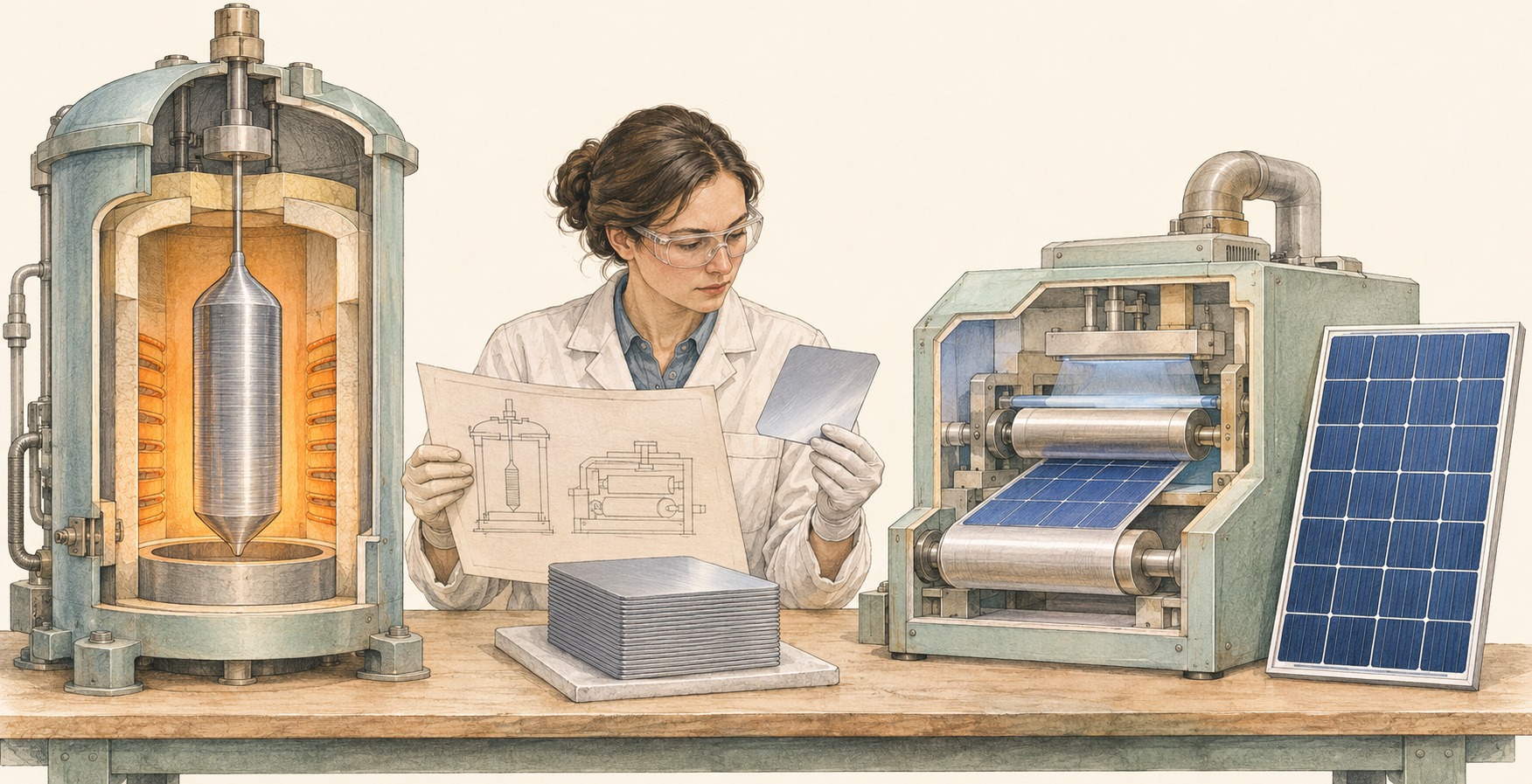
Why, then, do 12 of the 40 technology points (5 proposed prohibited, 7 proposed restricted) target solar manufacturing? Because China leads the world in turning raw quartz into ultra-pure polysilicon, pulling giant monocrystalline ingots, slicing wafers thinner than office paper, and coating next-generation tandem cells. As foreign governments offer subsidies and erect import tariffs to build domestic solar factories, Beijing is drawing a border around both the industrial recipes and the physical factory machines that carry them CN-A1 CNQA:
- Silicon purification (263003J & 263004X): Proposed prohibitions cover mega-scale cold-hydrogenation fluidized beds (\(\ge 250{,}000\text{ tonnes/year}\) trichlorosilane on a single line) and silane fluidized beds (\(\ge 20{,}000\text{ tonnes/year}\)); restricted entries cover \(\ge 30{,}000\text{-tonne}\) plant packages and \(\ge 800\text{-tonne-per-furnace}\) reduction recipes CN-A1.
- Ingot pulling and paper-thin wafers (263004J & 263005X): Slicing silicon wafers \(\le 70\text{ micrometers}\) thick (including control software, algorithms, and mechanical drawings) is proposed prohibited (
263004J). Restricted entries cover giant crystal pullers (\(\ge 1{,}600\text{ mm}\) chambers or \(\le 40\text{ kW}\) power draw), machining \(\ge 720\text{ mm}\) ingots, rectangular wafers (\(\ge 182\text{ mm}\)), and \(\le 130\text{-micrometer}\) slicing with \(\le 28\text{-micrometer}\) tungsten wire saws CN-A1. - Tandem and high-efficiency cells (263801J & 263802X): Proposed prohibitions guard mass-produced perovskite and silicon-perovskite tandem recipes (\(\ge 30\%\) cell efficiency, \(\ge 1.1\text{-meter}\) slot-die coaters, \(\ge 28\%\) large tandem modules) and thin-wafer edge passivation. Restricted entries cover high-throughput TOPCon, back-contact (XBC), and heterojunction (HJT) processes (\(\ge 25\%\) cell or \(\ge 22.3\%\) module efficiency) CN-A1.
Footnote 4: When the Physical Machine Is the Recipe
Just as AI software cannot be separated from AI chips, solar know-how cannot be separated from solar furnaces. When a supplier ships a deposition reactor, installs embedded control code, and trains foreign engineers for six months on the factory floor, the hardware carries the mind inside it.
Draft Note 4 covers specified core photovoltaic equipment when it embodies listed technical indicators, including reactors, crystal furnaces, wafer saws and coating machines. Covered exports require temporary pre-export registration now. If adopted, the final catalogue would distinguish prohibited technology from restricted technology that needs permission. A license would not make a prohibited transfer permissible; the final text and procedures must be checked. CN-A1, note 4 CNQA CNMEAS
What This Means for the Two Teams
A finished panel, a manufacturing machine and the knowledge used to operate it are different things. For a cooperating factory team, access to one does not supply all the others. The workbench question becomes which equipment and know-how can still move together under the applicable rules.
The two teams' starting point is in The Fortress Trap: How Both Sides Can Lose.