01. The Day Knowledge Got a Customs Booth
One Friday Afternoon, Two Very Different Clocks
Picture a city council announcing on Friday afternoon that it plans to lower the speed limit on forty stretches of highway next winter, and inviting citizens to write in with comments for thirty days. Then read the second half of the notice: starting that same Friday afternoon, a real tollbooth is already open on the highway, recording every covered truck that drives past, including trucks that left the warehouse yesterday and have not yet crossed the bridge.
That is almost literally how Announcement No. 48 of 2026 works. Issued jointly on 16 October 2026 by China's Ministry of Commerce (MOFCOM, led by its Bureau of Industry, Security, Import and Export Control) and the Ministry of Science and Technology (MOST) under China's Foreign Trade Law and Regulations on the Administration of Technology Import and Export, the document sets two separate clocks ticking at once CN48, sections I and III CNTIER:

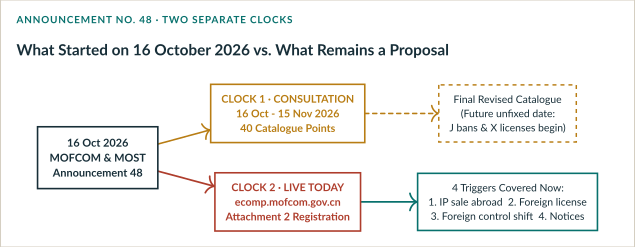
- The Consultation Clock (16 October to 15 November 2026): Beijing proposes adding 40 technology points (14 prohibited from export and 26 restricted) across artificial intelligence and chips (23), biomedicine (5), and solar energy (12) to the Catalogue of Technologies Prohibited or Restricted from Export. Until the public comment window closes and a final revised catalogue is formally promulgated, those new prohibitions and licensing rules remain proposals, not final bans CN48, sections I and II.
- The Registration Clock (Running Right Now): From the moment Announcement 48 went live on 16 October 2026 until the day the final revised catalogue eventually takes effect (a date Beijing has intentionally left unfixed), anyone exporting a technology listed in Attachment 1 must complete pre-export information registration online through MOFCOM's Unified Business System Platform at
https://ecomp.mofcom.gov.cnCN48, section III(1) CNPLAT.
Confusing those two clocks is the single most common mistake people make when discussing China's new rules. Registration is active today, yet registration is a reporting gate, not an export ban. Conversely, waiting until mid-November to pay attention can catch a startup or university lab off guard if it is signing an overseas license, shipping covered equipment, or closing a foreign financing round right now CN48 CNQA.
Crossing a Border Without Packing a Single Crate
When our grandparents heard the word export, they pictured harbor cranes lifting steel containers onto a cargo ship in Shanghai or Rotterdam. When a modern technology regulator says export, not a single wooden crate needs to touch a dock.
Under Section III(2) of Announcement 48, four transactions trigger mandatory pre-export registration before completion, including transfers that had already started before October 16 but are not yet finished CN48, section III(2):
- Selling the crown jewels abroad: Transferring ownership of domestic technology to an overseas buyer, such as assigning patents or selling proprietary model or chip intellectual property.
- Granting an overseas license: Keeping ownership in China while licensing a foreign partner, client, or subsidiary to use covered domestic technology outside the country.
- Changing who holds the steering wheel: A corporate acquisition, restructuring, or cap-table shift through which the owner or actual controller of domestic technology changes into an overseas entity. Even if every engineer and server stays in Hangzhou or Beijing, if ultimate corporate control crosses the border, the rule engages.
- Additional scenarios notified by MOFCOM: A statutory catch-all allowing the ministry to address new transfer structures by official notice.
When an exporter logs into the Technology Trade Management Information Application on ecomp.mofcom.gov.cn to file Attachment 2 (Technology Export Information Registration Form), the portal asks for concrete, auditable facts: the exporter's corporate identity and official company seal (公章), the technology owner, the foreign recipient's Chinese and English names, country, address, and corporate relationship to the exporter, the exact seven-character catalogue code and technical metrics, the end user and end use, whether the IP is self-developed, and the contract value converted into US dollars CN-A2. Multiple technologies transferred to the same overseas partner in one deal may be bundled onto one form; separate partners require separate filings CN48, section III(3).
Four Words That Change Everything
Legal catalogues look intimidating because casual readers read every line as a "ban." In practice, four regulatory categories carry vastly different meanings for human progress CN-A1, notes 1 to 4 CNQA CNTIER:
- Prohibited (
禁止出口, codes ending inJ) -
A solid red wall. Once finalized, covered technology within the stated scope cannot legally be exported at all CNTIER, Art. 32.
- Restricted (
限制出口, codes ending inX) -
A guarded gate with a lock and a key. Export is lawful, provided the exporter obtains official government permission before transferring the technology CNTIER, Art. 33.
- Automatic licensing (
自动许可) -
Proposed facilitation for specified restricted exports. MOFCOM describes the intended process as nearly immediate, but this is distinct from an exclusion and does not itself provide a final procedure or a guaranteed approval time. CN-A1, notes 2 and 3 CNQA
- Excluded (
不纳入管理范围) -
Outside this catalogue altogether. Already-public open-source AI and published academic papers sit here under Footnote 1, while ordinary laws like data security or copyright remain in place CN-A1, note 1.
Think of it like an international airport: prohibited items cannot fly; restricted items need a declared export permit; automatic licensing is the fast-track e-gate; and excluded items stay in your backpack without stopping at customs.
What This Means for the Two Teams
For our two teams, filing information before a covered transfer and being forbidden to transfer are different obstacles. The story asks what cooperation survives each rule. This chapter establishes which duty operates now and which catalogue changes remain proposed, before we judge their effects.
The two teams' starting point is in The Fortress Trap: How Both Sides Can Lose.