The project builder: crates and seams
Building a documentation project means: load conf.toml, discover and read the documents, resolve the project tables, write one builder’s output, and publish it. The project builder splits this work into crates with one responsibility each, so that builders, readers and the command line can be written, tested and reviewed apart. This page records the split and the seams between the crates. Each crate’s README.md is its API
cheat sheet.
The crates
Dependencies point one way, from the configuration up to the command line.
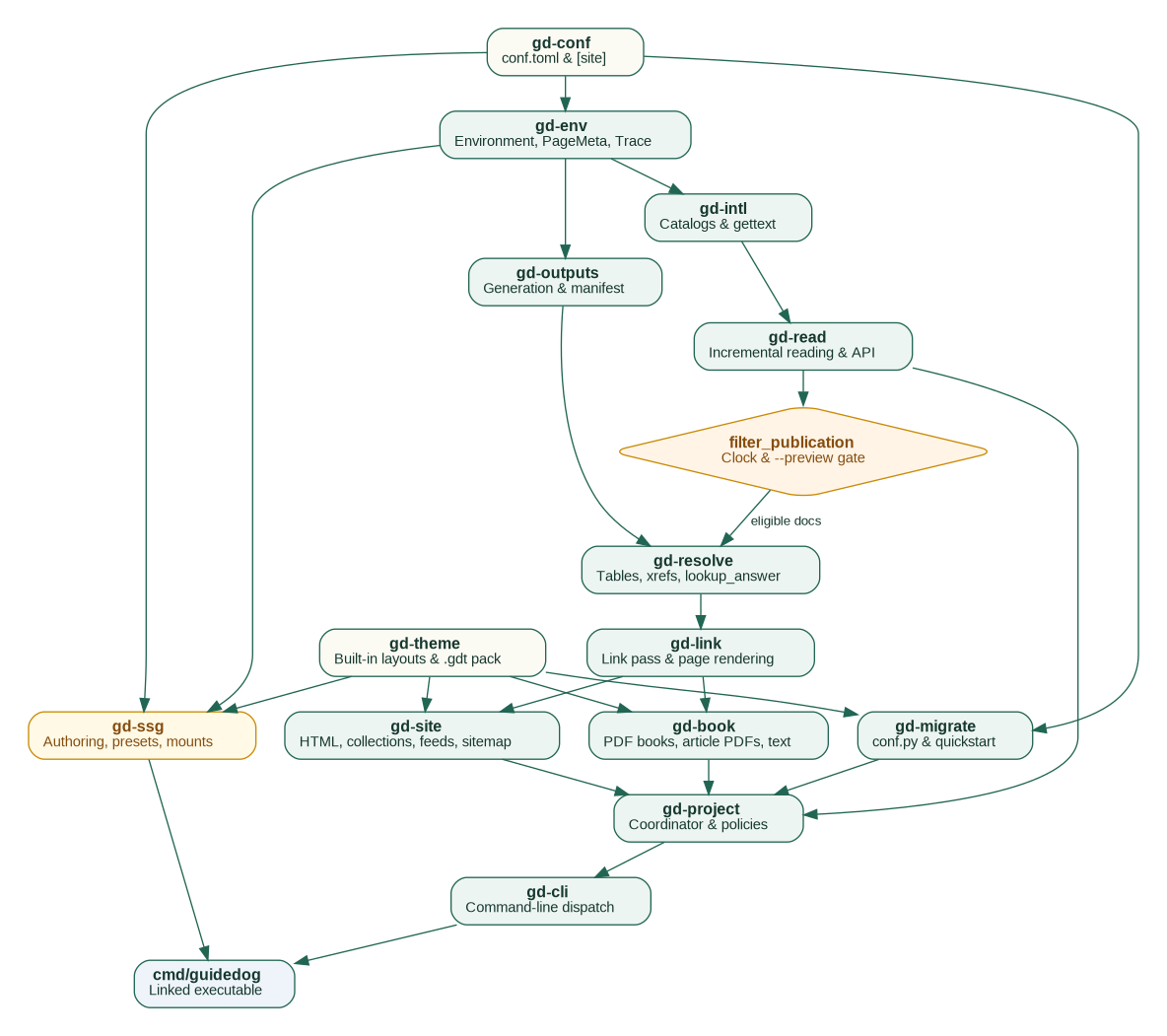
gd-serve (the preview server) needs only the standard library and gd-host;
gd-i18n (translating documents) only the engine and gd-gettext.
- gd-conf
-
conf.toml: theConfigmodel with Sphinx’s names and defaults plus[site](SiteConfig), loading (load_config,find_project),-Doverrides (apply_override), the checks Sphinx makes when it starts (check_config), the settings table gd-migrate convertsconf.pywith (SETTINGS,find_setting,suggestion), trust (readable_roots,confine,confine_untrusted,drop_machine_plugins), the content rules (ContentRule,ContentRules), andDigest. - gd-theme
-
Built-in HTML and Typst templates (
layout.html,article.html,landing.html,book.typ,discussion.typ,article.typ,theme.typ), CSS/JS assets (guidedog.css,guidedog.js,typography.js), and deterministic.gdttheme archive packing andguidedog-theme.lockverification. - gd-migrate
-
conf.pytoconf.toml, andguidedog quickstart. - gd-env
-
The foundation: build vocabulary (
BuilderKind,BuildOptions,BuildResult,OutputFormat,Asset,Rendered,UiText), discovery (discover,SourceFile), the environment (Environment,DocInfo,ineligible_docs), publication metadata and queries (PageMeta,PostlistSpec), the object store (ObjectStore), lookups and traces (Lookup,LookupKind,Trace), the settings digests, and the build plugins of one build (PluginRun). - gd-outputs
-
One
Generationper build and builder: output units, the manifest, reuse, the commit journal and publication, recovery of interrupted commits,clean. - gd-resolve
-
The project tables (
resolve), inventories (load_intersphinx), cross-reference resolution without the document tree (resolve_xref), the answers that verify a page’s trace (lookup_answer), the indexes’ data,BuildViewand theOutputBuildertrait. - gd-link
-
The link pass: rewrites a document’s tree for one output (references, images, numbers,
only, todo lists,postlistand rich excerpts, Graphviz graphs, andtypst-diagramand nativelilypondfigures) and renders the page. - gd-read
-
Incremental reading: parses changed documents, extracts leading
PageMetafields and symbols, and hosts autodoc, odindoc and rustdoc. - gd-site, gd-book
-
The builders: html, dirhtml and singlehtml (templates, taxonomy and collection archives, RSS/Atom feeds,
sitemap.xml, search index, static files); pdf (Typst books and standalone:pdf: articlearticle PDFs) and text. - gd-intl, gd-i18n
-
Catalogs, the interface translator, the gettext builder; the translation pass.
- gd-project
-
The coordinator and public surface:
Project,LoadOptions,load,build,clean,watch_roots,build_limits,content_policyand the trusted and untrusted policies. - gd-ssg
-
The linked static publishing plugin (
guidedog ssg): site presets, surgical metadata transitions, pinned.gdttheme installation, and mounted multi-project site assembly. - gd-cli
-
The command line, and
run_with(linked)for custom binaries. - gd-typst, gd-graphdog, gd-fetch, gd-git, gd-clock, gd-pages, gd-discussion
-
The sibling compiler, service and linked-plugin crates called by
gd-link,gd-book,gd-resolve,gd-ssgandcmd/guidedog(see Crates: reusable and internal).
Seams
S1: gd-conf
load_config(dir, &LoadOptions) -> Result<Loaded, Problem> with LoadOptions { conf_dir, no_config, overrides, source, output } and Loaded { config, warnings, settings }. Config keeps the general settings flat (project, root_doc, exclude_patterns, numfig, …) and groups the rest: mathjax, intersphinx, autodoc, ext (ExtensionSettings), odin_api, rust_api, plugins, html, pdf, graphviz, music, myst, intl, and site (SiteConfig: base_url, sitemap, feeds, taxonomies, page_size, collections, mounts, assets, theme). The Sphinx-compatible conf.toml keys stay flat while static publishing lives under [site]. ObjectTypeDecl, AutodocDefaultOption and IntersphinxProject are gd-conf’s own types; the crates that need them convert. Failures are gd_host::Problem (config.invalid, cli.define, project.missing, exit 2) and warnings gd_report::Report.
S2: gd-env
DocId(u32) indexes Environment::docs (sorted by docname). Environment also persists ineligible_docs so documents withheld by :draft:, :publish-at: or :expires-at: retain their cached DocInfo across clock-only builds without polluting active resolution tables. Digest is gd-conf’s, re-exported. SourceFile { docname, path, relative, kind, generated }; a generated page (an API page) carries its text and the files it was made from. DocInfo holds what the environment knows of a document, including page: PageMeta (extracted from the first root FieldList by page_metadata), with Option for every “none” and a CachedFile { path, digest } for the object and the search words. PostlistSpec encodes and evaluates chronological article queries for postlist directives and collections. load_environment(path, settings, fresh, &budget), ENVIRONMENT_VERSION 31. ObjectStore writes objects/<docname>.<digest16>.gdo and loads it into a guidedoc::Workspace. Lookup { kind: LookupKind, key } and Trace (each lookup once, including LookupKind::FileContent, LookupKind::Template, LookupKind::Postlist, LookupKind::Navigation, LookupKind::Excerpt, and LookupKind::Mount). Rendered { body, assets, trace, reports, failed }. trait UiText: Sync { gettext, ngettext }.
S3: gd-outputs
output_paths(&config, kind, output_dir) -> OutputPaths { out_dir, next, old, legacy, build_dir, doctrees, manifest, journal }. Generation::begin(paths, options, &mut reports) settles interrupted commits; reuse(key, inputs, answer) is the cutoff
point; unit(key) -> Unit (emit, emit_text, emit_copy, emit_tree,
stage_path, finish(UnitRecord), fail; dropped unfinished counts as failed);
commit(CommitRecords { environment, store }) -> CommitOutcome; dropping a generation
abandons it. clean(&config).
S4: gd-resolve
resolve(&config, &env, ui, &mut reports) -> Tables. BuildView<'b> borrows the
configuration, options, builder, environment, tables, inventories, object store,
registry, policy, limits, interface words, dates, plugin run, budget, readable roots and
output settings. resolve_xref(&view, &XrefQuery, &mut Trace) -> Result<Resolved, Box<Unresolved>>; Unresolved carries whether to warn, the code and category, a
hint and a “Did you mean”. lookup_answer(&view, page, &Lookup) -> Digest.
trait OutputBuilder { kind(); write(&view, &mut Generation, &mut reports) } is
implemented by gd-site, gd-book and gd-intl; gd-project maps each BuilderKind to one
in a single match.
S5: plugins
PluginRun::start(PluginStart { config, linked, kind, access }) looks each
selected ID up in the linked registry first, then, with PluginAccess::Any, in the machine registry; PluginAccess::None (an
--untrusted build) refuses any (plugins.untrusted); at most 64. One
Mutex<PluginSession> per plugin per build; process_source is called by gd-read,
process_html and assets by gd-site (HTML builders only). digest() (identity,
cache key, configuration and dependency files, assets) joins the reading and output
settings. Sessions stop when the run is dropped. gd_project::LoadOptions owns the
linked gd_plugins::Registry.
S6, S7
gd-read: read_documents(&ReadContext, previous: Environment, &[SourceFile]) -> Result<ReadOutcome, Problem>, which fails only when the registry has no reader for a document (build.reader); a document that cannot be read is a failed DocInfo in the outcome. api_sources makes the generated Odin and Rust API pages and reread_document reads a document again whose object is stale. The autodoc, odindoc and rustdoc hosts implement guidedoc-sphinx’s provider trait. gd-site: loads templates through gd_jinja::Environment with a confined loader (templates_path, an offline-verified _themes/<tree-sha256>/ when site.theme = true, then the built-in gd-theme assets), records fine-grained Template, Navigation and Postlist lookups per page, and emits taxonomy and [[site.collections]] archive units, RSS 2.0 and Atom 1.0 feeds, and sitemap.xml. gd-book: composes Typst books from pdf_documents and standalone article PDFs for eligible documents with :pdf: article (using _templates/article.typ or gd_theme::article_template).
S8: gd-project
load(dir, &LoadOptions { config, plugins, registry }) -> Result<Project, Problem>
checks the engine registry (core.registry.invalid; None is
guidedoc_defaults::registry()) and reads conf.toml. Project { config, warnings, settings, registry, plugins } is plain data. build(&project, kind, &options) -> BuildResult never fails outright; it runs, in order:
- The confinement (
BuildOptions::effective_confinement) on its own copy of the configuration:plugins.untrustedwhen no plugin may start,gd_conf::confinefor aReadScope::Withinbuild,drop_machine_pluginsforPluginAccess::Linked, andpdf_packages = "offline"without the network;output_pathsandGeneration::begin, which settles an interrupted commit first;build_limits(build.stack);PluginRun::start. discover,contents_root,api_sourcesandwith_generated: the sources.load_intland, except for gettext,localize_config;build_dates(fromoptions.nowor the clock);load_intersphinx(no network and confined local inventories when the confinement says so). The build stage becomes Reading.build_settings(reading settings, translations, trust, limits, plugins);load_environmentandread_documents; the documents’ reports join the build’s. Unlessoptions.previewis set, the publication clock filter partitionsenv.docsinto eligibledocsand withheldineligible_docsagainstnow.resolve; the stage becomes Writing. ABuildViewwithoutput_settings, and onematchonBuilderKind:SiteBuilder(html, dirhtml, singlehtml),PdfBuilder,TextBuilder,DummyBuilder,CoverageBuilder,GettextBuilder(withreread_documentas itsReread).suppress_warnings; then a build with an unread document (build.read) or, with-W, any warning or error (build.warnings) abandons its generation; any other commits it.publishedandunsettledcome from the commit.
BuildResult::written and unchanged are the generation’s units written and kept
besides the site unit (Generation::written_count, reused_count); a builder whose
whole output is the site unit (singlehtml, gettext) counts it as one output.
Ownership
No arena holds a project or a build. load returns an owned Project; a build
takes &Project and clones the configuration, so the type system enforces that a
build never changes its project (an --untrusted build confines only its own copy).
Only the coarse gd_host::Budget remains, for the files and sessions a build holds,
with --budget hints; BuildOptions::on_budget decides at the budget (a terminal
asks whether to raise it). Pages render on gd_host::run_workers: each worker owns a
guidedoc::Workspace and returns a Rendered; the main thread emits units in
docname order.