Publish one complete generation
A reader should never see half an updated site. This is a publication property. It is separate from parsing and rendering.
The invariant
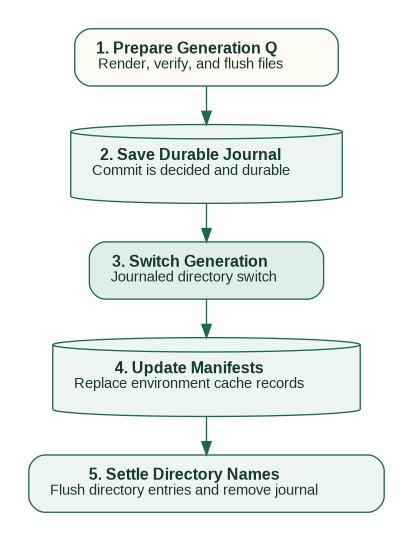
Let \(P\) be the published output tree. During preparation, \(P\) remains unchanged. The next tree \(Q\) is complete before the commit is decided. The commit journal names the output and the records that belong with it.
Preparation can fail. The host abandons the unfinished generation. A decided commit can be interrupted. The next build finishes or restores it from the journal. It does not guess from a staging directory’s name.
Why the cache is outside the output
A directory exchange moves everything inside the publication directory. A journal placed inside it would move during the very operation it describes. Its location would cease to be stable when recovery needed it most. Guidedog keeps records in a stable directory outside the publication tree. A custom output uses a sibling cache for this reason.
The spare output and the previous output live in the build directory too, as .<name>.next and .<name>.old.
For a default output this is the folder beside it: _build/.html.next sits next to _build/html.
For a custom output it is the sibling cache: -o locales/templates leaves locales/.templates.guidedog beside the output, and nothing else.
The cache is a sibling of the output, so it is on the same filesystem, and the switch stays one exchange or two renames.
Earlier versions kept a custom output’s .<name>.next and .<name>.old beside it.
The next build moves such a spare output into the cache, or removes the folder, and says so in a note.
It does this only when the folder is clearly Guidedog’s: every file in it is a stage file, a file the manifest names, or the same file (by inode) as the output’s file at that path.
A folder holding anything else, or a file with such a name, is left as it is, with a note that says so.
Durability and visibility
Flushing file contents is not the same as flushing directory names. The algorithm accounts for both before removing the journal. Platforms differ in how directories are exchanged. The recovery protocol is designed around those differences.
The implementation is split along that line. gd-outputs owns the generation. A
Generation value stages the next tree, records each output unit in the manifest,
writes the commit journal, and recovers an interrupted journal when the next build
begins. Dropping an uncommitted generation abandons it. gd-host owns the file
operations. Stage writes a file beside its target and removes it when dropped
uncommitted. exchange switches two folders in one call where the system offers it
(renameat2 on Linux, renamex_np on macOS). sync_all and sync_each
flush file contents and folder entries. Stage names keep one prefix
(.guidedog-stage-), so a later build removes what a killed process left.
This protects the project publication. It is not a distributed transaction with an external hosting provider. Copying a successful build to a server is another operation, owned by the deployment tool.
On filesystems with directory exchange, the output path switches in one operation. The fallback uses two renames and can briefly leave that path absent. It still never exposes a partly assembled tree. Journal recovery finishes or restores an interrupted switch. A client making several requests can span two generations; the build does not promise a snapshot for an entire browsing session.