
CCM
CODE, CHANGE, AND CONFIDENCE
Measure the code.
Understand the change.
A local source counter with a deeper question: what does a change affect, what still needs checking, and what resources should we budget?
Rust. No external runtime crates. Terminal, HTML, and JSON.
Linux, Windows, macOS, and FreeBSD. Source on GitHub.

COUNT / TRACE / EXPLAIN
01 / A familiar starting point
Count the source. A clear table of languages, files, lines, comments, and code, with explicit selection and language policies.
02 / A declared task
Follow the change. Trace affected parts, required checks, and the evidence that survives across a stated dependency model.
03 / Visible assumptions
Explain the estimate. Separate AI, tool, and human activities with an editable 2026 research profile and inspectable units.
A REPORT WE CAN READ
Clear enough for the first look. Detailed enough for the next question.
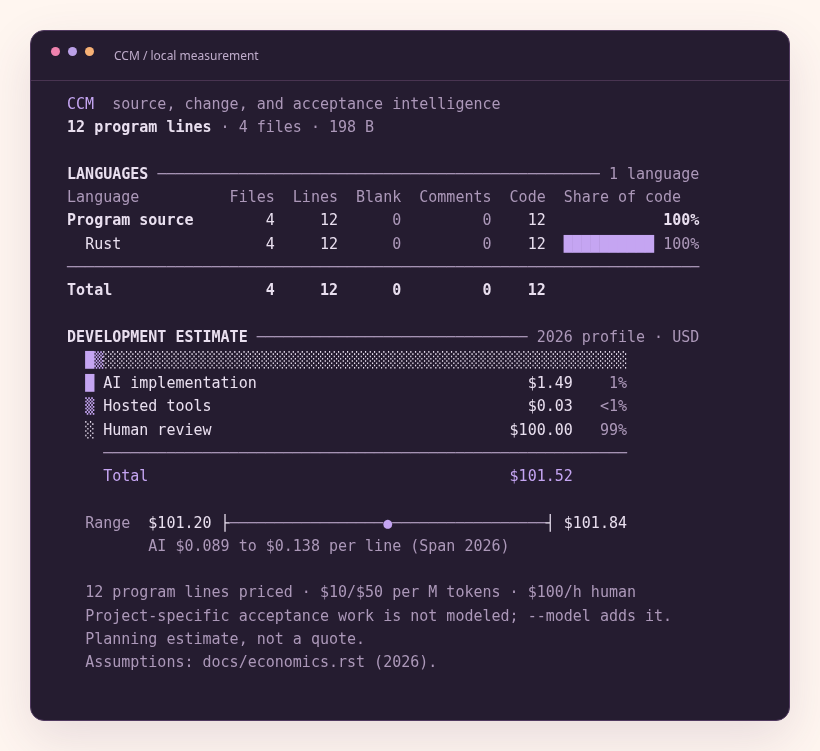
The normal CLI keeps the essentials close together. The technical view exposes the calculation. Standalone HTML carries the report into a meeting, while JSON preserves the structured result for an agent.
THE LINUX KERNEL IN TWO SECONDS
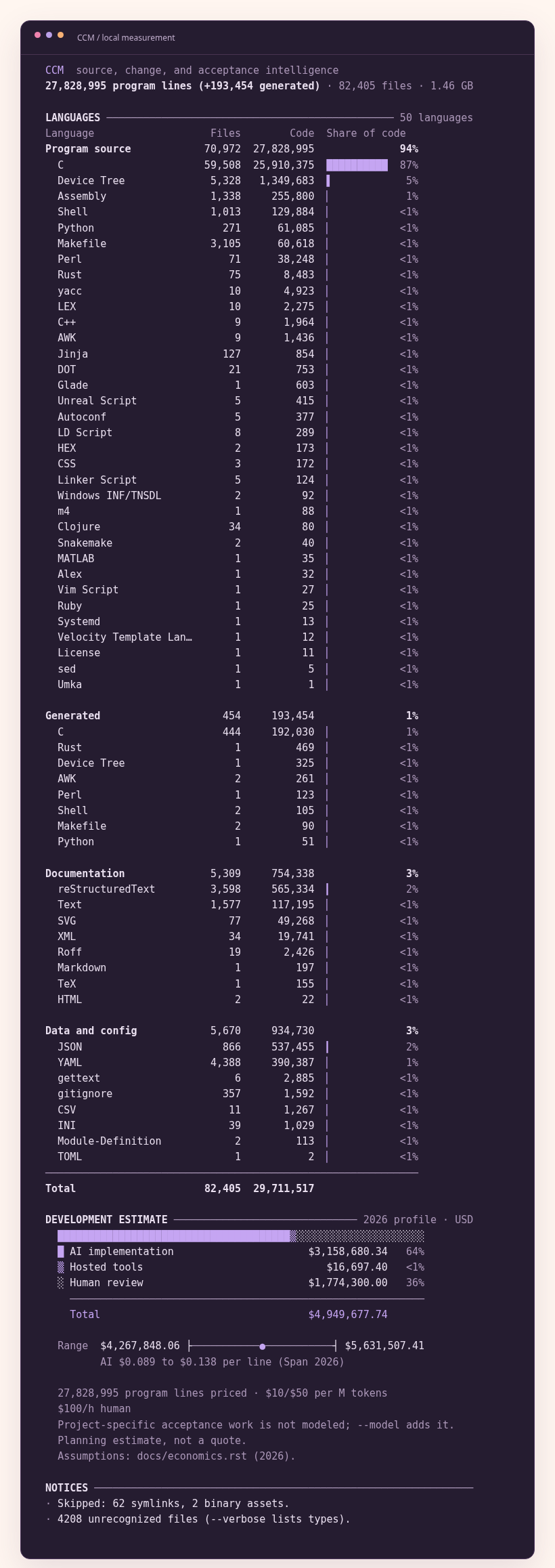
Twenty-eight million program lines, each one in exactly one class.
We ran CCM on the Linux 6.12 source release.
It counts 82,405 files and 1.46 GB in about two seconds with 125 MB of memory, and every file counts.
The image below is that run’s terminal output, captured by cargo xtask showcase and rendered without edits.
The same command writes the full HTML reports for Linux 6.12, FreeBSD 15.1, and Chromium 156 to the repository’s examples folder.
MORE THAN A BIG NUMBER
The reasons travel with the result.
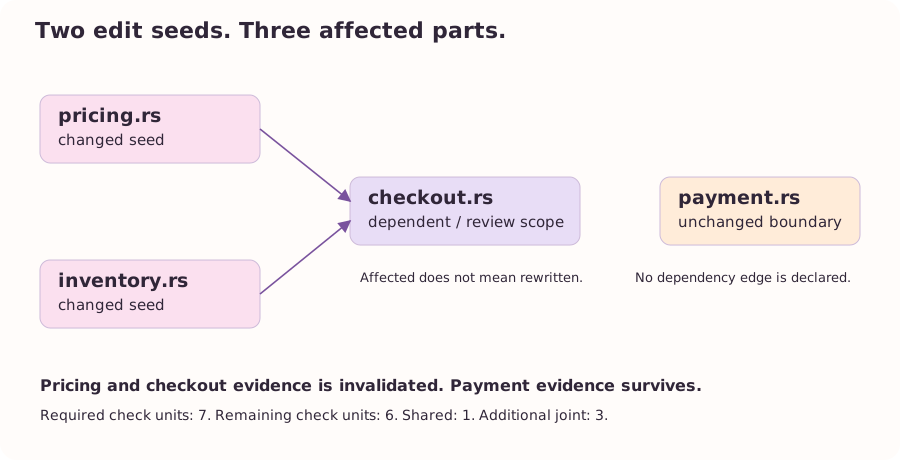
A small patch can invalidate several assumptions. Two edits can share a check and create another check that neither needed alone. CCM’s finite model keeps those relationships visible instead of hiding them in a single score.
The model is explicit. Counting a language does not imply that semantic dependencies have been extracted automatically. The book walks through the definitions, proofs, limits, and executable checkout example.
THE CCM BOOK
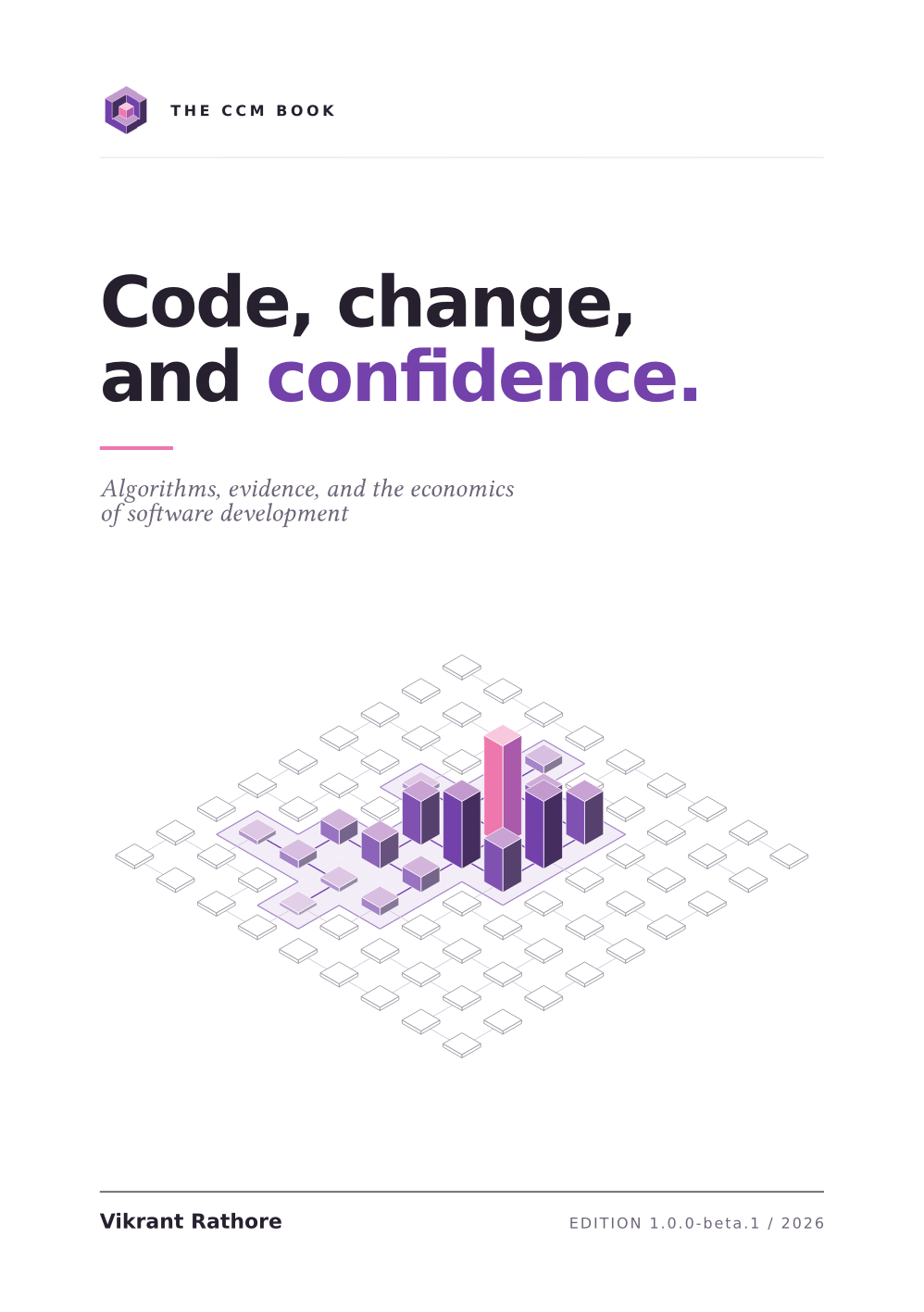
Code, change, and confidence.
A book about the things we can count, the changes we must understand, and the evidence we need before accepting them. We follow one example from source bytes to a review plan and a priced resource scenario.
Inside are algorithms, architecture layers, sequence diagrams, mathematical derivations, actual report screenshots, research questions, and a calibration plan. The web and PDF editions come from the same prose through Guidedog.
MEASUREMENTS WITH A METHOD
Counts we can check without trusting the counter.
We do not grade CCM against another counter. Each line class has a definition, and each definition implies a property that a short program checks on the input itself. Every physical line is in exactly one class, so code, comment, and blank lines add up to the line count. The blank lines are exactly the whitespace-only lines. A new policy version may move a line between code and comment, but it never changes a file’s line count. And CCM selects no file that Git ignores. These hold for every file of Linux 6.12, FreeBSD 15.1, and Chromium 156, which together hold more than 120 million program lines.
The registry contains 658 language and format names and aliases, with native and declarative policy tiers. The source definitions, raw measurements, and reproducible method are in the book.
Build it. Try a real tree.
Download a native executable or build from source. The beta release includes six platform archives, checksums, source provenance, and the PDF book.
On macOS and Linux we can install the matching archive through the CCM Homebrew tap.
brew tap insanai/ccm
brew install insanai/ccm/ccm
ccm .
For a source build:
git clone https://github.com/insanai/ccm.git
cd ccm
cargo build --release
cargo install --path cmd/ccm --offline
ccm .
ccm . --html -o report.html
ccm . --json -o report.json
The installed executable measures locally and does not execute source or contact an agent service. We can add an explicit task model when we need a change and acceptance report. The estimates remain resource scenarios with stated assumptions, and the full source inventory remains available without them.