The Guidedoc engine
Guidedoc is the conversion core: the guidedoc crate and the reader and renderer
crates it registers. It reads a source, builds a validated semantic tree, runs passes,
and renders bytes. It does not open files, run compilers, or publish artifacts. The
host does that. The engine crates use only the standard library, so another program can
embed them.
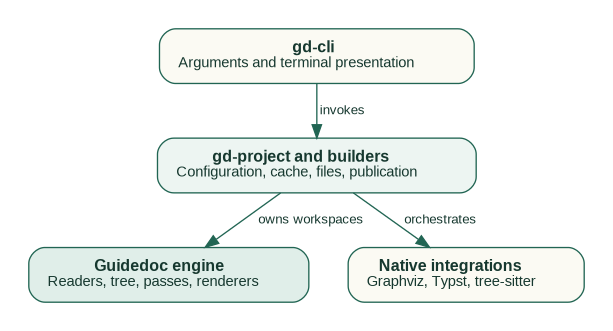
Crates and their direction
Dependencies point one way: the engine knows nothing of the crates above it.
guidedoc-
The AST, the builder and validator, diagnostics, the adapter registry, symbol tables, the object format, and the conversion pipeline.
- Readers and renderers
-
guidedoc-rst(withguidedoc-rst-inline),guidedoc-commonmark(CommonMark and MyST),guidedoc-sphinx(Sphinx directives, roles and domains, including theodinandrustdomains),guidedoc-cpp;guidedoc-html,guidedoc-typst,guidedoc-text, andguidedoc-rst-writer. guidedoc-defaults-
The built-in registry, and the adapter that joins
gd-highlightto the engine’sHighlightertrait. - The host
-
gd-hostmeets the operating system: sessions, confined files, atomic publication, the coarse budget, worker threads, crash reports. The project builder (gd-conf,gd-env,gd-read,gd-resolve,gd-link,gd-outputs,gd-site,gd-book,gd-intl,gd-project) andgd-clisit above it, andcmd/guidedogis the program.
Supporting libraries (gd-toml, gd-json, gd-jinja, gd-highlight,
gd-gettext, gd-graphdog, gd-typst, …) never depend on guidedoc; only
adapters join them to the engine. Typst lives only inside gd-typst.
Conversion data flow
A document passes through distinct stages. Each stage works in the caller’s
Workspace, which keeps its buffers between conversions:
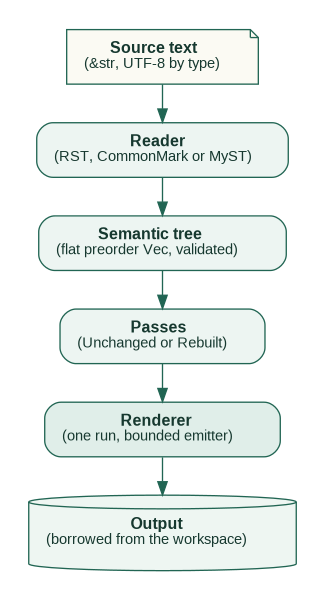
The staged calls are read_document, transform_document, check_render and
render_document. convert runs them for one request. convert_text is the
one-call path with a default request:
use guidedoc::{convert_text, Workspace};
let registry = guidedoc_defaults::registry(); // the built-in readers and renderers
let mut ws = Workspace::new(); // reuse it: buffers are kept
match convert_text(&mut ws, ®istry, "commonmark", "html", "# Hello\n") {
Ok(html) => println!("{html}"), // borrows ws until the next convert
Err(fail) => eprintln!("{fail}"), // title, message, and hint
}
Every failure is a Fail { status, need, diagnostic }. The status is the class
(InvalidInput, Unsupported, Policy, Capacity, Limit, Cancelled,
Internal). The diagnostic has a stable code, a title, a message, and a hint.
The boundary
The workspace owns its tables as Vec and String values. It clears them between
conversions and keeps their capacity, so the engine’s own work in steady state allocates
nothing. A test with a counting allocator checks it. Readers and renderers keep their
working state in the workspace’s Scratch store too; a second counting-allocator test
bounds any remaining warmup or lossy-report allocations per reader and renderer pair and
checks that they do not grow (see Memory and ownership and Testing). Growth driven by the input uses
try_reserve and stays within Limits (nodes, text bytes, output bytes, reports,
depth, work, stack, includes). So running out is a Capacity or Limit result,
never a panic. A third-party compiler has its own allocation rules. The guarantee covers
the conversion boundary, not the whole process. See Memory and ownership.
The tree
Nodes have newtype ids (NodeId(u32)). Hot columns hold the kind and the subtree
range; cold tables hold the payloads particular kinds need. A flat preorder Vec lets
a traversal skip a whole subtree without following pointers.
For node \(i\), let \(e_i\) be its exclusive subtree end. The subtree occupies \([i,e_i)\). A leaf has \(e_i=i+1\). A parent closes after its descendants. See Invariants before algorithms for the interval proof and Guidedoc AST contract for the normative node shapes.
The API
The API has few concepts and plain data. Requests are public-field structs built from
default_request with struct-update syntax. Registries are immutable values holding
reader, pass, and renderer descriptors. There is no runtime plugin discovery and no
global registration. Readers are Reader constants whose read function builds
nodes with the builder. Renderers walk the document and write to the emitter. A pass is
a closure that returns Unchanged at no cost or copies what it keeps into a rebuilt
tree.
Ownership is the key rule, and the compiler enforces it. A Document<'ws> borrows
its workspace, so a document or an output cannot outlive the next conversion, and a
stale or foreign handle does not compile, so no generation or revision check is needed at run time.
A result the host keeps must own its text. The crate’s README.md is the API cheat
sheet. The generated reference is guidedoc, and the design record is GDS
0003 in docs/gds.