Crates: reusable and internal
Some of Guidedog’s crates are useful beyond Guidedog. We structure those for independent reuse and cargo package (with crate names reserved for crates.io) and keep the rest internal to the program.
Take one library
When another Rust program only needs to read TOML, we add one line to its Cargo.toml:
[dependencies]
gd-toml = "1.0.0-beta.16"
fn main() {
    let text = "[site]\ntitle = \"Guide\"\n";
    match gd_toml::parse(text) {
        Ok(table) => {
            let title = table.path(&["site", "title"]).and_then(|v| v.as_str());
            println!("{title:?}");
        }
        Err(err) => eprintln!("{err}"),
    }
}
The program receives gd-toml and gd-report, nothing else: no engine, no Typst, no command line. Every reusable crate is like this. It needs only other reusable crates and the few external crates the project chose, so taking one never pulls in the program around it.
To convert documents, we take the engine instead. guidedoc-defaults registers every reader and renderer, so one dependency and one call convert MyST to HTML:
fn main() -> Result<(), guidedoc::Fail> {
let registry = guidedoc_defaults::registry();
let mut ws = guidedoc::Workspace::new();
let html = guidedoc::convert_text(&mut ws, ®istry, "myst", "html", "# Hello\n")?;
println!("{html}");
Ok(())
}
A program that needs only CommonMark and HTML registers guidedoc_commonmark::READER and guidedoc_html::RENDERER itself and leaves the other readers out. Each crate’s README starts with such a complete program.
Two groups
The reusable crates are the engine, the supporting libraries, the API generators and the plugin SDK. Each is packageable (publish is enabled, with names reserved for crates.io), has a README written for a reader who has never seen Guidedog, and keeps its API for other projects as well as for ours.
The three native music libraries remain unpublished during the beta, as GDS 0015 requires; their dependency direction and APIs still support independent use.
The internal crates are the parts of the Guidedog program: configuration, the project builder, the site and book builders, translation, publication and the command line. They set publish = false. Their APIs follow the program’s needs and change with it, so we promise nothing about them to anyone else.
The engine
The engine crates use only the standard library, so they embed wherever Rust compiles.
guidedoc-
The document engine: the AST, the builder and its validation, the workspace that owns and reuses the document tables, limits, diagnostics, the registry of readers and renderers, and the one-call
convert_textbeside the staged pipeline. guidedoc-rst-
The reStructuredText reader: block structure, explicit markup and every standard Docutils directive, with the extension points the Sphinx layer uses.
guidedoc-rst-inline-
reStructuredText inline markup and reference resolution, shared by the rst reader and the Sphinx layer.
guidedoc-commonmark-
CommonMark 0.31.2 (reader id
commonmark) and MyST Markdown (myst). guidedoc-sphinx-
Sphinx’s directives, roles and domains (py, c, cpp, js, rst, std, math, odin, rust) for both the rst and the MyST reader.
guidedoc-cpp-
C++ declarations parsed as Sphinx’s C++ domain parses them, with every id version. It knows nothing of documents;
guidedoc-sphinxturns its data into nodes. guidedoc-html,guidedoc-typst,guidedoc-text,guidedoc-rst-writer-
The renderers: HTML, Typst source (compiled to PDF elsewhere), plain text as Sphinx’s text builder writes it, and reStructuredText that reads back into the same tree.
guidedoc-defaults-
One registry with every reader and renderer and the code highlighter:
guidedoc_defaults::registry(). guidedoc-edit-
Editable source maps of reStructuredText and Markdown documents, read with the Sphinx and MyST readers, and edits that keep every untouched byte (GDS 0017). It needs the readers and
gd-report.
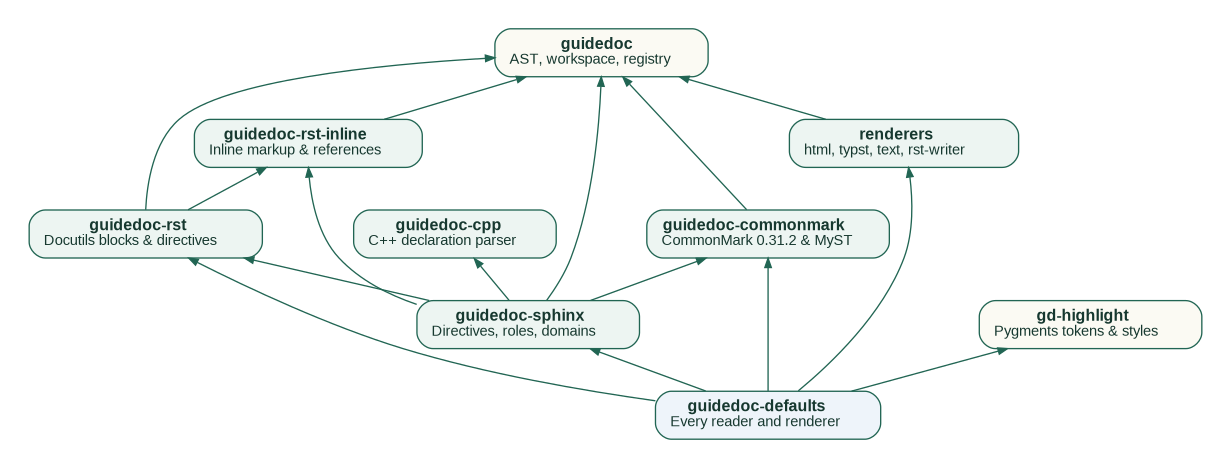
guidedoc-defaults also points at guidedoc directly; the drawing leaves that edge out. guidedoc-cpp needs nothing at all: it is a parser with plain data, so the Sphinx layer, not the parser, decides what a declaration becomes in a document.
Libraries
The libraries never depend on the engine. That is why the engine can use them through adapters while another program uses them alone.
gd-report-
Elm-style diagnostic reports (title, location, excerpt with carets, hint) rendered as text or JSON. The other libraries’ errors become these reports.
gd-toml-
A TOML 1.0 parser and writer; every value knows its line and byte offset.
gd-json-
JSON over
serde_json: duplicate-key and depth checks, HTML-safe output. gd-sha,gd-flate-
SHA-256, SHA-1 and FNV-1a; DEFLATE and zlib with output limits.
gd-jinja-
A Jinja 3.x template engine.
gd-highlight-
Syntax highlighting with Pygments’ token classes and styles for 35 languages.
gd-gettext-
GNU gettext PO and MO catalogs, plural forms, merging and statistics.
gd-graphdog-
Graphviz DOT to SVG, PNG or DOT with the Graphviz C library in process. It is the one crate that links a C library: the system’s shared
libgvcandlibcgraphby default, or the static Graphviz thatcargo xtask graphvizbuilds whenGUIDEDOG_GRAPHVIZ_STATICnames it (as release builds do). gd-score-
Exact checked rational time, spelled pitches and a flat score model with typed indices and source spans; no dependencies or file access.
gd-lilypond-
A bounded LilyPond notation reader over
gd-scorewith explicit include callbacks, retained source files and structured diagnostics; no Scheme or external program execution. gd-engrave-
Native score geometry, exact spring spacing, bounded optimal line breaking and outlined SVG over
gd-score, SMuFL metadata, Rustybuzz and ttf-parser; one explicit font set and reusable workspace per rendering thread. gd-inventory-
Sphinx object inventories (
objects.inv) for intersphinx.
API generators
The generators read source code without compiling or running it and write reStructuredText for the Sphinx domains.
gd-pyscan-
Static analysis of Python modules with tree-sitter.
gd-autodoc-
Sphinx autodoc’s output from
gd-pyscan’s analysis. gd-odindoc-
Odin packages, read for every build target at once, for the
odindomain. gd-rustdoc-
Rust crates, read with tree-sitter, for the
rustdomain.
Plugin SDK
gd-plugins-
Typed build plugins and publishers, linked into a program or served as programs over the JSON Lines protocol (see Plugins: SDK and process protocols).

The notes are the only external crates the reusable crates use. guidedoc, guidedoc-cpp, gd-report, gd-sha, gd-flate, gd-jinja, gd-highlight, gd-gettext and gd-odindoc need no other crate.
Internal crates
Every other package is internal:
- the host and project layers:
gd-host,gd-conf,gd-env,gd-outputs,gd-serve,gd-i18n,gd-read,gd-resolve,gd-link,gd-mathml,gd-site,gd-book,gd-intl,gd-migrate,gd-pagesandgd-project; - the command line and its services:
gd-cli,gd-capabilities,gd-theme,gd-discussion,gd-ssg,gd-fetch,gd-git,gd-typstandgd-clock; - the programs under
cmd/, the tools undertools/, the examples underexamples/and the end-to-end tests undertests/integration.
gd-theme embeds the built-in HTML and Typst templates (layout.html, article.html, landing.html, book.typ, discussion.typ, article.typ, theme.typ) and the browser assets (guidedog.css, guidedog.js, typography.js) so that quickstart, gd-site and gd-book share one source without a runtime data folder. Its pack module encodes, decodes, and verifies deterministic .gdt theme archives and guidedog-theme.lock files offline.
gd-ssg implements the linked guidedog ssg plugin and authoring surface: site presets (project, journal, research), surgical front-matter and field-list transitions (new, draft, schedule, publish, status), explicit SHA-256-pinned .gdt theme installation, and multi-project [[site.mounts]] website assembly (guidedog ssg build), whose editions are built in child processes as many at once as fit in memory (GDS 0020, with gd_host::Schedule). It owns no renderer; mounted builds run through the standard Guidedog project pipeline.
gd-mathml writes formulas as MathML Core. It translates a formula’s LaTeX with guidedoc-typst, compiles all formulas of a document in one run of the embedded Typst compiler, and passes each result through the MathML filter of guidedoc-html. It is the only crate that joins the HTML renderer to the compiler, so guidedoc-html stays free of Typst.
gd-typst embeds the Typst compiler and runs it both for PDF books and articles and for typst-diagram SVG and PNG figures. It also exposes lazy text-font handles and bounded standalone SVG rasterization for native music. Keeping it internal keeps Typst’s large dependency tree out of every reusable crate: guidedoc-typst writes Typst source as text, and only the program compiles it.
gd-fetch reads URLs and files and sends HTTP requests for remote intersphinx inventories, pinned .gdt theme archives and the Pages publisher. It uses ureq, a small blocking HTTP client, with rustls for TLS and Mozilla’s root certificates built in (webpki-roots). Guidedog therefore needs no curl program, OpenSSL or system certificate store, and request headers never appear on a command line. The crate stays internal, so the reusable crates do not carry an HTTP stack.
gd-clock gives the program one answer to “what time is it?”. A build stamps its output with SOURCE_DATE_EPOCH when reproducible builds set it, and with the clock otherwise. The crate turns Unix seconds into civil dates with plain arithmetic and asks the operating system only for the local time zone’s offset from UTC. That offset is the crate’s one piece of unsafe code (localtime_r on Unix, SystemTimeToTzSpecificLocalTime on Windows), so the rest of the program needs none for dates. The plugin SDK gd-plugins is reusable and cannot depend on it; it keeps its own few lines of date arithmetic.
Rules the gate checks
The dependency gate in tests/integration (tests/gates/dependencies.rs) reads cargo metadata and checks three rules for publication:
- every reusable crate is publishable, and every internal one sets
publish = false; - a reusable crate needs only other reusable crates (dev-dependencies are not published, so they are free);
- every path dependency of a reusable crate asks for the workspace version.
The last rule exists because crates.io needs a version beside each path. The root [workspace.dependencies] names it once per reusable crate, and we bump it together with [workspace.package] version and VERSION; the gate fails if we forget one.
What a package holds
A package holds its src folder, its README and, for gd-plugins, gd-odindoc and guidedoc-rst-writer, its examples. Tests and their fixtures stay in the repository: the conformance corpora would make the engine packages several times larger, and a user of the crate does not run them.
We see what a crate would publish, and package several crates at once, with:
cargo package --list -p gd-toml
cargo package --no-verify --allow-dirty -p gd-report -p gd-toml
Packaging several crates in one call lets each resolve the others before they are on crates.io.
To make an internal crate reusable, we first move its dependencies on internal crates out, then add it to REUSABLE in the gate, give it the package metadata the others have (description, keywords, categories, include, readme), and list it on this page.