committed
ZDS 0001: The Zen Discussion Process#
Abstract#
The zenfmt monorepo needs a durable decision-record process for architectural, format, performance, and documentation changes across the conversion library and the zenfmt command-line tool. A document converter accumulates decisions that are invisible in the code and expensive to relearn: which parts of a source format are deliberately dropped, why a construct maps to one Markdown spelling rather than another, and what the plugin contract promises a reader that the engine will never do on its behalf. The project uses Zen Discussions, or ZDS, as RFC/RFD-style Typst documents that support structured reasoning, long-lived references, high-quality PDF output, and an HTML discussion website.
This memo defines the lifecycle of a ZDS, the placeholder numbering workflow, the authoring expectations, and the Typst project layout.
Introduction#
A Zen Discussion is a Typst document stored in git under docs/zds/records. Each discussion is part design memo, part review artifact, and part historical record. The structure is intentionally close to IETF RFCs and Oxide RFDs because those formats force explicit scope, status, rationale, alternatives, and operational considerations instead of relying on implicit context.
ZDS is used for topics such as:
- the document intermediate representation and its compatibility rules
- the plugin contract: what a reader may assume, what a writer must handle
- the mapping from a specific source format to the IR, and the constructs that mapping deliberately discards
- performance and allocation budgets, and the benchmarks that defend them
- security decisions, notably the handling of untrusted archive and markup input
- contributor and documentation process decisions
Active design reasoning, trade-offs, and decisions belong in ZDS. The Typst book under docs/book/, when it is written, remains the descriptive manual of the current system; a ZDS records why the system became that way.
Why a converter needs written records#
Every format zenfmt reads is a lossy projection onto one shared IR, and every format it writes is a lossy projection back out. The interesting engineering is almost entirely in those two projections, and almost none of it is legible from the code alone. A reader that skips a construct and a reader that has not yet implemented that construct look identical in a diff. Only a record distinguishes them.
This is why a mapping decision — even a small one, such as rendering a single-cell table as a paragraph — belongs in a numbered document with the alternatives that lost.
Terminology and Scope#
- ZDS: a Zen Discussion document
- placeholder draft: a local Typst draft using the placeholder number
XXXXX - assigned ZDS: an accepted discussion with a permanent four-digit number
- registry: the Typst metadata list in
docs/zds/registry.typused by the index and bundle entry point - bundle: the experimental Typst export target that emits the HTML index, HTML discussion pages, and per-ZDS PDFs from one entry point
This memo defines the repository workflow for ZDS. It does not define future CI automation in full detail, but it does define the expected behavior of that automation.
Discussion Lifecycle#
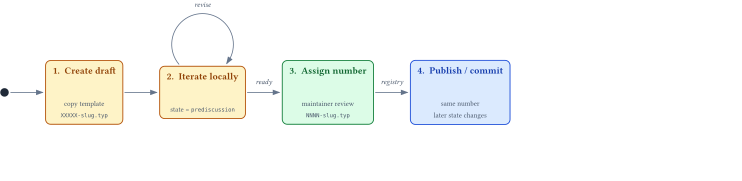
New discussions begin as placeholder drafts.
- Contributors copy
docs/zds/template/rfc-template.typtodocs/zds/records/XXXXX-<slug>.typ. - The document uses the placeholder number
XXXXXwhile the author iterates. - The registry-driven Zen Discussions index includes placeholder drafts after assigned discussions.
- When the draft is ready, maintainers assign the next permanent ZDS number and rename the file to
NNNN-<slug>.typ. - The registry is updated with the document’s area, status, summary, source path, HTML path, and PDF path.
This keeps cloning and local authoring simple. Contributors do not need a global lock or remote numbering check just to start writing.
Local Workflow Diagram#
States#
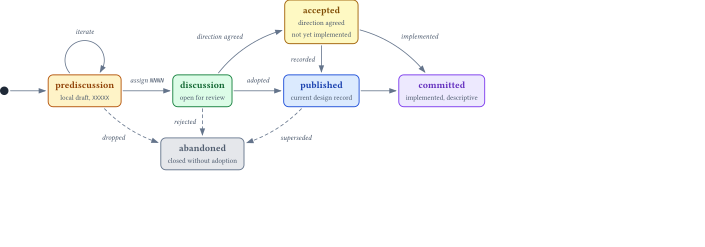
ZDS documents can move through these states:
prediscussion: local draft or early working documentdiscussion: open for review and feedbackaccepted: accepted as the intended direction, not yet fully implementedpublished: accepted into the repository as the current design recordcommitted: fully implemented and now descriptive of the current systemabandoned: deliberately closed without adoption
State Transition Diagram#
Solid edges are the forward path of a discussion; dashed edges close a document without adoption. The filled dot is the moment a contributor copies the template.
Transition Detail#
| Transition | Actor | What happens |
|---|---|---|
start → prediscussion | contributor | Copy template/rfc-template.typ to records/XXXXX-<slug>.typ and iterate locally under the placeholder number. |
prediscussion → discussion | maintainer | Run zig build zds-promote -- <slug>: it assigns the next four-digit number, renames the file to NNNN-<slug>.typ, rewrites the metadata for discussion, and appends the registry.typ and bundle.typ entries. |
discussion → accepted | maintainers | Review converges on the proposed direction; implementation has not landed yet. The registry state changes, nothing is renamed. |
discussion → published | maintainers | The document itself is the deliverable (process memos, assessments, records) and is adopted as the current design record. |
accepted → published | maintainers | The accepted direction is written up as the repository’s current design record while implementation continues. |
accepted / published → committed | maintainers | The described system is fully implemented; the ZDS is now descriptive of the current system rather than a proposal. |
any pre-committed state → abandoned | maintainers | The discussion is deliberately closed without adoption: dropped while drafting, rejected in review, or superseded by a later ZDS. The number is never reused. |
Authoring Rules#
ZDS documents SHOULD follow the RFC-style template in docs/zds/template/rfc-template.typ.
Each ZDS is expected to include, at minimum:
an abstract or decision summary
a clear statement of scope and goals
the main design or proposal
considerations for security, operations, or workflow where relevant
alternatives and unresolved questions
Keep one ZDS per file under
docs/zds/records.Store document metadata in the
#let zds-*assignments at the top of the file.Update
docs/zds/registry.typwhenever a ZDS is added, renumbered, renamed, or changes lifecycle state.Build through
zig buildonce Zig is installed; Typst remains the document compiler.
The ZDS Typst layer is allowed to use external Typst packages for diagrams, charts, richer tables, or specialized layout when those packages improve the clarity of the PDF output. The repository should prefer existing Typst packages over building a custom extension framework here.
Format Records#
A ZDS that adds or changes a format plugin carries three sections beyond the template, because these are the parts of a converter that reviewers cannot reconstruct from the diff:
- Mapping table: every source construct the plugin recognizes, and the IR node it produces. One row per construct.
- Deliberate omissions: source constructs the plugin sees and drops on purpose, each with the reason. This is the section that distinguishes a decision from a gap, and it is the section reviewers should read first.
- Round-trip expectations: what survives a conversion to the target format and back, and what does not. A converter that claims fidelity it does not have is worse than one that documents its losses.
Two rules follow from the shared IR. A change to Block, Inline, or their tags affects every plugin at once and requires its own ZDS. A change confined to one plugin’s mapping does not, and may be recorded as an amendment to that plugin’s existing record.
Typst Project Layout#
The ZDS tree is a first-class Typst project:
docs/zds/records/contains standalone ZDS source files.docs/zds/template/rfc-template.typis the starting point for new ZDS drafts.docs/zds/registry.typis the metadata registry used by the index and bundle.docs/zds/index.typrenders the PDF/HTML index from the registry.docs/zds/bundle.typuses Typst bundle export to emitindex.html, one HTML page per ZDS, and one PDF per ZDS.docs/shared/zds.typanddocs/shared/theme.typprovide the shared document frame, styling, and index components.docs/book/anddocs/book.typhold the skeleton of the future zenfmt book. The theme, callouts, and figure helpers are in place; the chapters are not written yet, and no build step compiles them.
Typst bundle export and HTML export are experimental in Typst 0.15. They are useful for the ZDS website, but the repository should still keep standalone PDF compilation for each ZDS as the stable archival path.
Build Integration#
The root build.zig owns the ZDS build steps. Records are discovered by scanning docs/zds/records, so adding a record never requires a build-file edit:
zig build zdscompiles every numbered record todocs/build/zds-NNNN-<slug>.pdf.zig build zds -Dzds=<number-or-slug>compiles a single record; the number may be unpadded (-Dzds=2), and a placeholder draft can be selected by its slug for proofreading before promotion.zig build zds-indexcompiles the registry-driven index todocs/build/zds-index.pdf.zig build zds-sitecompiles the experimental HTML bundle todocs/build/zds-site/.
Lifecycle management is owned by tools/zds.zig:
zig build zds-listprints registry entries and placeholder drafts, and warns when a record file and the registry disagree.zig build zds-new -- <slug>createsrecords/XXXXX-<slug>.typfrom the template with today’s date.zig build zds-promote -- <slug>performs theprediscussion→discussiontransition described above.
Direct Typst commands are useful while editing:
typst compile --root docs docs/zds/records/0001-zds-process.typ \
  docs/build/zds-0001-zds-process.pdf
typst compile --features html,bundle --root docs --format bundle \
  docs/zds/bundle.typ docs/build/zds-site
Number Assignment and CI#
The repository supports a local numbering workflow for maintainers who manage discussions directly in git history. The tools/zds.zig command, wired into the build as zds-list, zds-new, and zds-promote, automates it:
- list current ZDS entries and placeholder drafts
- assign the next permanent four-digit ZDS number to a placeholder draft
- rename the file from
XXXXX-<slug>.typtoNNNN-<slug>.typ - rewrite the
zds-numbermetadata and transition the document into discussion - append the metadata entry to
docs/zds/registry.typand the export blocks todocs/zds/bundle.typ
The tool performs ordinary file edits reviewed in the same change as the discussion — there is no hidden state, and every step can still be done by hand. The generated registry summary and area come from the draft’s zds-discussion and first zds-labels entry; review both before committing.
That local flow is sufficient for small teams and direct-maintainer repositories. A future CI workflow can still:
- detect placeholder ZDS files that are ready for discussion
- reserve the next permanent ZDS number
- rename the file from
XXXXX-<slug>.typtoNNNN-<slug>.typ - rewrite the
zds-numbermetadata
Both flows preserve a stable numbered sequence in shared history. Teams can choose local CLI assignment, CI assignment, or a combination where CI validates numbering but maintainers assign numbers intentionally.
Numbering State Diagram#

Security Considerations#
An ambiguous discussion process creates implementation drift and undocumented design assumptions. For a converter this is not cosmetic. zenfmt parses untrusted input by construction: its whole purpose is to accept a file someone else produced. Decisions about archive expansion limits, entry-count and decompression-ratio caps, XML entity expansion, and path traversal inside container formats are security decisions, and they must stay traceable to an explicit record rather than living as an unexplained constant in a parser.
Requiring explicit sections for scope, considerations, and alternatives reduces the chance that such limits are relaxed later by someone who cannot see why they were chosen.
References#
IETF RFCsfor explicit memo structure, status, and considerationsOxide RFDsfor engineering discussion records in a source repositoryTypst bundle exportfor the multi-file ZDS website and per-ZDS PDFs- ZDS 0002, the zenfmt architecture and implementation record