Every Format Is a Container#
Every Format Is a Container#
Three families#
Every input zenfmt accepts arrives in one of three shapes. The shape decides which support library opens it, which limits guard it, and which attacks it must survive.
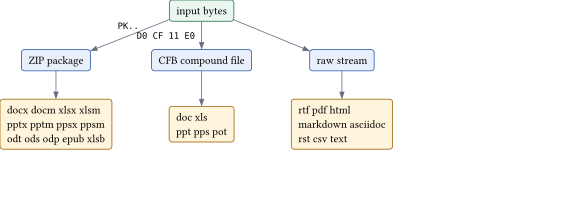
zenfmt_ooxml opens ZIP packages and zenfmt_cfb opens compound files. Stream formats parse their bytes directly.The dispatch is content sniffing. It is not faith in file extensions. A ZIP container names its own subtype. The characteristic part names appear verbatim in the central directory: word/document.xml, xl/workbook.bin, ppt/presentation.xml. The OpenDocument and EPUB families carry a mimetype entry, and its value is stored uncompressed for exactly this reason. Detectors can find application/vnd.oasis.opendocument.spreadsheet or application/epub+zip without inflating anything.
A compound file names its subtype one level down. Its directory entries are UTF-16LE stream names. Finding WordDocument, Workbook, or PowerPoint Document in the directory sectors settles doc versus xls versus ppt. Nothing needs to be parsed first.
The ZIP discipline#
The ZIP reader in zenfmt_ooxml reads the central directory only. Local file headers are advisory copies. A hostile archive makes them disagree with the directory, so zenfmt never walks them. From the directory it accepts exactly two compression methods, stored and deflate, and it enforces the archive limits of chapter 6 while streaming, not after.
Three rules have no override flag, because no legitimate document needs one:
- A hostile entry name rejects the whole archive before any entry is read. Hostile means absolute, drive-lettered, or containing
... - An encrypted entry is a refusal, never a skip.
- Any compression method other than stored or deflate is a refusal.
Decompression is budgeted per entry. An entry may expand to at most max(compressed_size, 64) times max_compression_ratio bytes. The check runs as the inflate stream produces output. A zip bomb therefore dies in the middle of the stream with docx.archive-limit, or the sibling code of whichever format opened the archive. It costs zenfmt the budget, not the bomb’s full yield.
The compound-file discipline#
The legacy binary formats predate ZIP-in-Office by a decade. Their container, MS-CFB, is a small FAT filesystem inside a file. It has 512-byte sectors, a File Allocation Table mapping each sector to the next, and a directory of 128-byte entries with UTF-16LE names. Streams smaller than 4,096 bytes live in a mini stream of 64-byte mini-sectors with its own mini-FAT.
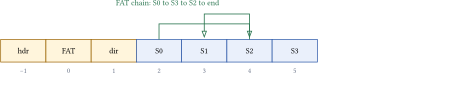
zenfmt_cfb gives format libraries the same API shape the ZIP reader gives: Cfb.open(arena, bytes, limits), then find(name), then readStream(arena, entry, limits). Every chain walk is bounded by the sector count. The bounded walks cover the FAT, the DIFAT, the mini-FAT, and the directory. A cyclic FAT produces doc.not-a-compound-file rather than a hang. The library also owns the two text helpers every CFB tenant needs, cp1252 and UTF-16LE decoding, because the formats inside predate UTF-8.
XML as events#
Between the container and the reader sits one more shared machine: the pull parser in zenfmt_xml. It produces events, never a tree. The events are element_start, element_end, text, and done. A hundred-megabyte document.xml therefore costs bounded memory. Three decisions matter more than its size:
- No DTD, ever. A
DOCTYPEdeclaration is refused outright, withdocx.doctype-refusedand its siblings. Office software never writes one. Entity-expansion attacks require one. The only entities that decode are the five predefined names and numeric references. - Namespaces match by URI. Elements match on the pair of namespace URI and local name, never on prefix. A document that renames
w:tox:parses identically. - Depth is bounded. An explicit stack capped by
max_xml_depthmakes deep nesting a limit report, not a stack overflow.
DOCX: resolution before mapping#
WordprocessingML separates what a paragraph is from what it references. The reader (ZDS 0003) therefore resolves before it maps.
- Styles. A paragraph names a style id. The file
word/styles.xmlchains styles throughbasedOn, bounded at 16 hops. The chain decides whether the paragraph isHeading1throughHeading9. A heading arrives asheadingwith its level. Every other named style is preserved as plugin data in the manifest, so a future DOCX writer can restore it. - Numbering. A list item names a pair,
numIdandilvl. The fileword/numbering.xmlmaps concrete to abstract numbering, which decides bullet versus ordered. Word stores no list structure at all, so zenfmt synthesizes it with a stack keyed on level. A level jump opens intervening empty items. A level decrease closes lists. Each table cell gets its own list base, so a table never leaks list state. - Fields.
HYPERLINKlives in a field machine.fldChar beginstarts instruction capture.separateparses the URL and opens a link.endcloses it. Readers keep the cached field result. The instruction text never leaks into output.
Character formatting is a set of flags on runs: bold, italic, strike, superscript, subscript, small caps, underline. Markdown wants nesting instead. Every flag-based reader (DOCX, RTF, ODT) converts flags to the canonical nesting order and shares the common prefix between consecutive runs.
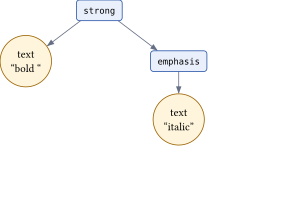
strong node. This is the tree a person would draw.Tables read their column count from tblGrid before the first row. Leading tblHeader rows route into table_head. A gridSpan becomes the cell’s col_span. A vMerge continuation cell folds into its originating cell. These degradations file one docx.merged-cells-degraded note per table, not one per cell.
Spreadsheets: one projection, three encodings#
All four spreadsheet formats project identically. Each sheet becomes a level-2 heading carrying the sheet name, then one GFM table whose first row is the header. The reason is simple: a user comparing .xlsx output with .xls output should see the same document. What differs is only the cell encoding.
| Format | Encoding | The characteristic trap |
|---|---|---|
| xlsx / xlsm | XML: <c r="B2" t="s"><v>7</v></c> with shared strings. Styles map numFmtId to date or percent. | Self-closing <row/> and <c/> elements produce no end event. Both must still materialize, or the table loses its shape. |
| xlsb | Binary records in a ZIP: a record id of 1 or 2 bytes, a length varint of 1 to 4 bytes, then records such as BrtCellRk, BrtCellIsst, and cached BrtFmlaNum. | BrtBundleSh in real files carries a 40-byte preamble where the spec example shows 36. The reader accepts both by requiring exact record consumption. |
| xls | BIFF8 records in a CFB stream: BOUNDSHEET, SST with CONTINUE splits, RK packed numbers, FORMULA plus a cached STRING. | An SST string may switch encodings at a CONTINUE boundary. The 1904 DATEMODE flag shifts every serial date. |
Dates deserve a sentence. A spreadsheet date is a float counting days from an epoch. zenfmt renders it as ISO YYYY-MM-DD using the civil-from-days algorithm, never a locale. A formula converts as its cached value. When the cache is absent, the reader files one formula-without-cached-value note and moves on. zenfmt evaluates nothing.
Presentations: the honest projection#
A slide deck is a spatial, animated medium. A Markdown file is neither. Every presentation reader emits an unconditional warning before its first slide: pptx.presentation-projection, ppt.presentation-projection, or odp.presentation-projection. The warning states that positioning, animation, and non-text shapes do not survive. This is the report system used exactly as designed. The loss is structural and guaranteed, so the diagnostic is unconditional. --strict turns it into a refusal for pipelines that must not accept it.
What does survive: slide order from sldIdLst resolved through relationships, title placeholders as level-2 headings, body text with bullet levels rebuilt as nested lists, a:tbl tables, external hyperlinks resolved through each slide’s own relationship part, images with their alt text, and speaker notes as a container classed notes. The binary .ppt walks its record tree instead. Every record is a header of version, instance, type, and length. The reader harvests TextHeaderAtom classifications and the TextCharsAtom or TextBytesAtom payloads under them. ODP walks draw:page frames classed title, outline, and notes, and reads slide tables from table:table elements inside frames.
OpenDocument text: styles and a re-parse trick#
ODT keeps heading levels in the open: text:h carries text:outline-level. Lists are explicit. Those two facts remove DOCX’s two hardest inferences. The difficulty that remains is style resolution. A text:span names an automatic style. That style may chain by style:parent-style-name into styles.xml. Only at the end of the chain does the reader learn that fo:font-weight is bold.
One implementation detail is worth retelling. Footnote bodies appear inline, inside the paragraph that references them. The AST wants note bodies deferred to the end. So the reader captures the note body’s raw byte range during the main pass and re-parses it afterwards. The captured fragment floated free of its namespace declarations, so the reader wraps it in a synthetic <office:wrap> element that re-binds the office:, text:, table:, draw:, and svg: prefixes. The pull parser neither knows nor cares that the document is synthetic.
EPUB: a website in a box#
EPUB is ZIP holding XHTML. META-INF/container.xml names the OPF package. The package’s manifest maps ids to files. Its spine fixes reading order. Dublin Core metadata (dc:title, dc:creator, dc:language) becomes document metadata in the manifest. Each spine chapter then flows through the same HTML machinery the standalone HTML reader uses: parseFragment with the chapter’s directory as a base, so relative image and link targets rebase onto archive-entry paths. Chapters concatenate without synthetic headings. The book’s own headings are trusted. A META-INF/encryption.xml file means epub.drm-refused, with no override.
PDF: geometry, not structure#
PDF is the one input with no document structure at all. It is placed glyphs. The reader (ZDS 0011) parses the object graph: classic xref tables and cross-reference streams, object streams, FlateDecode with PNG predictors. It decodes text through ToUnicode CMaps or the standard encodings. It tracks the text matrix and a glyph-width pen, so words join and split where the geometry says they do.
Structure is then recovered, conservatively. A font-size histogram per document sets heading tiers: a line at 1.6 times the body median or more becomes h1, at 1.35 times h2, at 1.12 times with bold h3. Vertical gaps split paragraphs. Hyphenated line-wraps rejoin. Tables are claimed only when the geometry insists. That means a drawn lattice of rules, or start-x positions clustering into the same columns across at least three consecutive baselines. Paragraphs win every doubt. Embedded images are saved as-is where the encoding permits: JPEG and JPEG 2000 streams verbatim, Flate bitmaps wrapped losslessly as PNG, through the media pipeline of chapter 7. Where it does not permit (CCITT, JBIG2), they are counted in pdf.images-omitted. The unconditional pdf.layout-projection warning tells the user exactly what kind of recovery they are reading.
Legacy Word: the piece table#
The .doc WordDocument stream does not store text in order. The File Information Block points into a table stream, named 0Table or 1Table (a FIB flag says which). The table stream holds the piece table: a sorted array of character positions (cp) paired with descriptors that map each cp range to a file offset (fc) range. Bit 30 of the fc marks 8-bit cp1252 pieces; without it, the piece is 16-bit UTF-16LE.
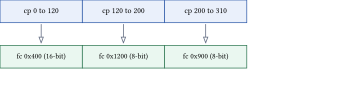
Paragraph marks arrive as \r characters in the decoded stream. Heading styles resolve through the stylesheet (STSH) by built-in style identifier. The paragraph’s style index is found through the PAPX formatted-disk-page chain. Hyperlink fields hide between the field characters 0x13, 0x14, and 0x15. The reader keeps the cached result and parses the instruction for its URL. Cell marks (0x07) flatten into paragraphs with a doc.tables-flattened note. That is the honest reading of a structure this reader does not yet rebuild.
What each format loses, and what the facets carry#
Every reader’s ZDS record carries the full table. This is the shape of it. The point is not the losses themselves; every converter loses these. The point is that each loss has a name you can grep for in the manifest, and that since IR v2 a third column exists: information Markdown cannot hold that now rides in typed facets, carried for a richer writer instead of merely mourned.
| Format | Converts faithfully | Deliberate, reported losses | Carried in facets |
|---|---|---|---|
| docx | headings, styled runs, links, lists, tables, footnotes, images | comments (docx.comment-dropped), text boxes, merged cells degrade (docx.merged-cells-degraded) | style names, tracked insertions and deletions, page size, image bytes as resources |
| rtf | styled text, tables, lists, links, footnotes, headings | image bytes (rtf.images-dropped), OLE objects (rtf.objects-dropped), nested tables flatten | stylesheet names on styled paragraphs |
| xlsx/xlsb/xls/ods | typed cells, dates, cached formula values, sheet structure | charts, cell formatting | grid facets: sheet, exact row and column, value type, formula source where the format spells it, cached value, merges |
| pptx/ppt/odp | titles, body text, tables, links, images, notes | animation, charts (presentation-projection) | slide geometry in EMU (pptx, odp), per-slide provenance (ppt), picture bytes as resources (pptx) |
| odt | headings, styles, lists, tables, images, footnotes | sourceless frames (odt.frame-dropped) | common style names, annotations as comment revisions, image bytes as resources |
| epub | chapters in spine order, metadata, images, links | CSS entirely, fonts; DRM’d books refuse (epub.drm-refused) | per-chapter provenance naming the spine member |
| text, headings by size, paragraphs, geometric tables, embedded images | layout itself (pdf.layout-projection), unmappable glyphs (pdf.unmappable-text), CCITT and JBIG2 images | page positions in EMU with projected confidence, per-page provenance | |
| doc | full text in both encodings, heading styles, hyperlinks | table grids flatten (doc.tables-flattened), embedded objects | STSH style names, heading provenance with stream positions |
Carried is not converted. The Markdown artifact is the same either way; the facets ride in the manifest as counted, digested summaries, and in full under --preserve-facets. What changed is that the loss ledger now distinguishes three fates instead of two: rendered, reported as lost, or carried for a writer that can use it.
Exercise 4.1.
Take any.docx you own and run zenfmt file.docx --reports=json. Match every report code you receive to a row of the omissions table in ZDS 0003. Which losses did your document actually exercise?Hint: Most documents trip two or three codes, not the whole table.
Exercise 4.2.
Rename a real.xlsx to evil.docx and convert it. Explain the output using the content-signature rule. Then find the sniffing order in core/src/root.zig that made it work.