Embedding and Filtering#
Embedding and Filtering#
One call, one result#
The whole library is reachable from one function:
const zenfmt = @import("zenfmt");

var conversion = zenfmt.convert(gpa, io, .{
    .input = .{ .path = "report.docx" },
    .output = .{ .path = "report.md" },
});
defer conversion.deinit(gpa);
Look at what convert returns. It is not !Conversion. It is Conversion, unconditionally:
pub const Conversion = struct {
    status: Status,               // .success or .failed
    reports: []const Report,      // every diagnostic, structured
    manifest_json: ?[]const u8,   // canonical JSON; null on failure
    exit_class: report.ExitClass, // .conversion, .usage, or .limit
    stream: StreamState,          // what a .writer output received
    arena_state: std.heap.ArenaAllocator.State,
};
stream answers a question only streamed output can raise: did the caller’s writer receive nothing, a partial prefix, or the complete artifact? A failed streamed conversion is thereby distinguishable from a successful conversion of an empty document. Path output reports .none; its transactional commit makes the question moot.
One failure cannot allocate a report: running out of memory while building reports. For that case the library keeps one reserved, statically allocated report, with code core.out-of-memory. It is returned without touching the allocator. Your error path can rely on conversion.reports being non-empty and renderable even then.
The arena you are handed#
Everything inside the result lives in one arena: the report strings, the manifest bytes, the document that briefly existed. convert created the arena, and its state travels inside the result. deinit promotes it back and frees everything at once:
pub fn deinit(c: *Conversion, gpa: std.mem.Allocator) void {
    var arena = c.arena_state.promote(gpa);
    arena.deinit();
    c.* = undefined;
}
Two consequences are worth internalizing. First, the slices in reports and manifest_json are valid until deinit and not one instruction longer. Copy them out if they must outlive the result. Second, one conversion is one arena. There is no per-node allocation to leak and no destructor order to get wrong. The whole memory story of a conversion is this pair of calls.
Rendering what happened#
Conversion.renderReports writes the same Elm-style text the CLI prints. An embedding application does not reimplement the diagnostic format:
if (conversion.status == .failed) {
    var buffer: [4096]u8 = undefined;
    var stderr = std.Io.File.stderr().writerStreaming(io, &buffer);
    try conversion.renderReports(&stderr.interface, .{});
    try stderr.interface.flush();
}
For machines rather than people, iterate conversion.reports directly. Each report carries a stable code, a severity, a loss tier, and concrete directions. exit_class classifies the worst failure: .usage for mistakes a flag fixes, .limit for resource refusals, .conversion for everything else. The CLI maps the classes to exit codes 2, 3, and 1. Your service can map the same classes to HTTP statuses or retry policies.
The options, one field at a time#
pub const ConvertOptions = struct {
    input: InputSpec,           // .path, or .bytes with a display name
    output: OutputSpec,         // .path, or .writer (*std.Io.Writer)
    from: ?[]const u8 = null,   // explicit input format
    to: ?[]const u8 = null,     // explicit output format
    limits: Limits = .{},       // every resource bound, overridable
    overwrite: bool = false,    // replace existing artifact + manifest
    strict: Strictness = .off,  // graded refusal of declared loss
    preserve_facets: bool = false, // full facet rows in the manifest
    pipeline: ?*const Pipeline = null,
};
input as .bytes is how a server converts uploads without touching the filesystem. The name field exists only for reports and format detection. output as .writer streams the artifact anywhere and skips every file side effect. No adjacent manifest is written, but manifest_json still carries it. Path output stages complete temporary files, then publishes the artifact, extracted media, and finally the manifest. Each file is individually atomic, and the last manifest certifies the ensemble. A crash between renames can leave a complete artifact or media file without a manifest; that state is deliberately uncertified and a rerun with --overwrite repairs it.
Python: the same conversion as a value#
The zenfmt Python distribution packages the default bundle behind a typed, dependency-free API. Its common path is deliberately one call:
import zenfmt

conversion = zenfmt.convert("report.docx")
print(conversion.text)
for report in conversion.reports:
    print(report.code, report.problem)
With no output, the returned Conversion owns the artifact bytes, canonical manifest, reports, and every embedded resource. Supplying an output path asks the same native publisher used by the CLI to commit the complete ensemble:
conversion = zenfmt.convert(
    uploaded_bytes,
    name="upload.docx",
    output="build/report.md",
    strict="structure",
    limits=zenfmt.Limits(max_input_bytes=64 * 1024 * 1024),
)
A Python string is always a path, never inline document text. That explicit path grants read authority for the file and for one adjacent, digest-bound manifest probe. Bytes and binary readers grant no filesystem authority: their name is display-only and is never opened. External resource references are returned as metadata and never fetched. The library has no environment configuration, runtime download, plugin discovery, or network access.
Every Python failure follows the same Elm-style diagnostic shape as the CLI. Applications branch on error.code, retain structured reports, and show str(error) or error.hint to a person. Argument mistakes remain ordinary TypeError or ValueError, but their messages still state the problem, consequence, and a concrete next action under What you can do:.
Browser: the same engine as a WebAssembly package#
The tagged browser distribution is also published as the dependency-free npm package @insanai/zenfmt. The package contains the audited WebAssembly module, ES module adapter, dedicated worker, TypeScript declarations, and generated capability contract.
$ npm install @insanai/zenfmtimport {
createWorkerConverter,
wasmUrl,
workerUrl,
} from '@insanai/zenfmt';
const converter = await createWorkerConverter({ moduleUrl: wasmUrl, workerUrl });
const result = await converter.convert(file, { timeoutMs: 30_000 });
console.log(result.text);
converter.dispose();The package does not add a network conversion fallback. The module has no host imports, and conversion remains on the caller’s machine. npm is only a distribution option for browser applications. The native CLI and server stay self-contained and do not require Node or npm.
Bundles: bring only the formats you need#
The CLI’s 19 readers are a choice, not a floor. core.Bundle builds a conversion engine from any descriptor tuple, at compile time:
const core = @import("zenfmt_core");
const markdown = @import("zenfmt_markdown");
const docx = @import("zenfmt_docx");

const Slim = core.Bundle(.{
    .readers = .{ docx.reader, markdown.reader },
    .writers = .{markdown.writer},
});

// Slim.convert has the same signature and contract as zenfmt.convert.
Duplicate format names, colliding extensions, and a reader and writer sharing one plugin id are compile errors. The messages follow the same four-question structure as runtime reports. The engine inside the bundle knows no format names. Its tables are generated from exactly the descriptors you passed. A slim bundle is not a configuration of the big one. It is the engine, smaller.

Filters, in the manner of build.zig#
zenfmt has no embedded scripting language. A filter is a Zig type. A pipeline is a value you build in your own program. The compiler checks the whole thing. This is the same trade build.zig makes: the extension language is the implementation language. There is no serialization boundary, no interpreter to sandbox, and no API surface that exists only in documentation.
The five that ship#
| Filter | Options | What it does |
|---|---|---|
filters.shift_headings | .{ .by = i8 } | Adds a constant to every heading level, clamped to 1..6. |
filters.promote_first_heading | .{} | Moves a leading level-1 heading into document metadata as the title. |
filters.drop_empty_containers | .{} | Unwraps container and span nodes carrying no attributes. Genuinely useful after HTML and DOCX. |
filters.flatten_nested_tables | .{ .placeholder = "..." } | Replaces a table nested in a table cell with a placeholder paragraph and files a warning report. |
filters.strip_classes | .{ .pattern = "tmp-*" } | Removes classes matching an exact name or a prefix* wildcard. |
Each exists twice over. It is a useful transform, and it is a worked example of one part of the contract: a typed payload edit, a metadata edit, .unwrap, a subtree replacement with a report, an attribute rewrite.
Writing your own#
The examples/filters/ project in the repository is a complete, compiling answer, and it is short enough to read whole. Its build depends on the zenfmt package. Its main.zig is a program:
pub fn filters(p: *zenfmt.Pipeline) void {
    p.add(zenfmt.filters.shift_headings, .{ .by = 1 });
    p.add(InternalLinks, .{ .base = "https://docs.example.com/" });
    p.add(zenfmt.filters.drop_empty_containers, .{});
}
Pipeline.add takes the filter type and a value of that filter’s own Options type. Pass the wrong shape and the program does not compile. Order is exactly the order written. The custom stage is a declaration:
const InternalLinks = zenfmt.Filter(.{
    .id = "example.internal-links",
    .description = "Rewrite fragment links to absolute URLs",
    .options = InternalLinksOptions,
    .inline_tags = &.{.link},
    .idempotent = true,
    .visit_inline = visitLink,
});
Two fields deserve attention. inline_tags declares the candidate set. This filter can only ever edit link nodes, so the engine scans the tag column (one contiguous u8 array) and skips the visit machinery entirely for a document containing no links. idempotent is a promise the test suite can check: running the stage twice equals running it once.
The visit function is ordinary Zig with a typed context:
fn visitLink(
    options: *const InternalLinksOptions,
    ctx: *zenfmt.FilterContext,
    node: zenfmt.ast.InlineIndex,
) zenfmt.FilterError!zenfmt.FilterAction {
    const link = switch (ctx.inlineView(node).content) {
        .link => |value| value,
        else => unreachable,
    };
    const target = ctx.text(link.url);
    if (!std.mem.startsWith(u8, target, "#")) return .keep;

    const absolute = try ctx.fmt("{s}{s}", .{ options.base, target[1..] });
    try ctx.replaceLinkTarget(node, absolute);
    return .replace;
}
Build it and the binary carries the pipeline:
$ zig build
$ ./zig-out/bin/zenfmt-filtered --list-filters
Filters, in pipeline order:
  core.shift-headings  Shift every heading level by a constant
  example.internal-links  Rewrite fragment links to absolute URLs
  core.drop-empty-containers  Unwrap containers and spans with no attributes
$ ./zig-out/bin/zenfmt-filtered --filters manual.md --stdout
## Guide

See [the intro](https://docs.example.com/intro) and [other](https://ziglang.org).
The fragment link became absolute. The # heading became ##. Both transforms ran inside one binary that is also a complete zenfmt. The last line of the example’s main hands the pipeline to zenfmt.cli.main.
What a visit may do#
FilterContext is the entire authority a stage has. For inspection it offers block and inlineView (typed views), text (byte ranges to slices), hasClass, attribute, and parents, the ancestor tag stack. The ancestor stack is how flatten_nested_tables knows it is inside a cell. For editing it offers the typed replacements (replaceHeadingLevel, replaceLinkTarget, replaceBlockAttrs, replaceInlineAttrs, makeAttrs), whole-subtree rebuilding (beginReplaceBlock hands you the same Emitter readers use; commitReplaceBlock seals it), and one document-level edit (setMetaInlines). Two utilities round it out: fmt allocates into the conversion’s arena, and report files a diagnostic that lands in the manifest like any reader’s.
What a visit cannot do is mutate the tree in place. Every action is recorded as an edit. The engine applies them all at once.
Discovery, then rebuild#
A pipeline stage runs in two passes. The discovery pass visits candidate nodes in source order and collects edits. If the list is empty, the stage returns the input document: the same value, no copy of any kind. The identity case is not merely fast. It is measured. The test “an identity pipeline appends no AST storage” in tests/filters.zig asserts that the block, inline, and text arrays did not grow.
With edits, the rebuild pass copies the spine (the path from the root to each edit) and bulk-copies every untouched subtree, column by column. A subtree is a contiguous slice in preorder storage. So “copy this untouched chapter” is one memcpy per column, not a traversal.
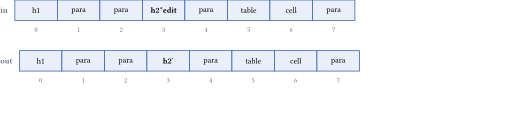
Side-table indices survive a rebuild because those tables are append-only. A rebuilt tree’s nodes still point at the same text pool, the same attrs, the same targets, plus whatever the stage appended. That is why ctx.fmt can hand a filter a new string without invalidating anything.
Failure and the validator#
Every stage’s output is validated before the next stage sees it: all eleven tree invariants. A stage that fails mid-rebuild rolls the store back by truncating to marks recorded at the stage boundary. A failed pipeline never leaks a half-rebuilt document into your error path. You get .status == and either
.failedcore.invalid-document-tree or the stage’s own report.
Reading facets#
A filter or an embedding application that wants more than flow can ask the document for its facets. The lookup is two steps, both cheap: node to entity, entity to facet row. A node without facets has no entity and the first step answers null, which is the whole cost of facets to code that ignores them.
if (doc.blockEntity(index)) |entity| {
    if (doc.gridOf(entity)) |cell| {
        // cell.sheet, cell.row, cell.col, cell.formula, cell.cached
    }
    for (doc.revisionsOf(entity)) |revision| {
        // revision.kind, revision.author, revision.timestamp
    }
}
Five accessors cover the five kinds: provenanceOf, styleOf, layoutOf, and gridOf return at most one row; revisionsOf returns a slice, because one span can carry an insertion and a comment at once. Layout coordinates are EMU from a top-left origin regardless of source format; the reader that attached them already did the arithmetic. Extracted binary content lives in the resource store, doc.store.resources, each entry carrying its source name, MIME type, bytes, and a BLAKE3 digest computed at registration.
The manifest as an integration surface#
Every path conversion commits <output>.zenfmt.json beside the artifact. Every streamed conversion returns the same bytes in manifest_json. The encoding is the zenfmt canonical JSON profile: UTF-8, bytewise-sorted keys, exact integers, no whitespace. It is deliberately not RFC 8785, which orders keys by UTF-16 code units and forces every number through a double; the profile is specified in core/src/json.zig and pinned by goldens. Two identical conversions are byte-identical, so a digest of the manifest is meaningful.
| Key | What a consumer may rely on |
|---|---|
source, artifact | Name, format, plugin id, and BLAKE3-256 digest of each side. The artifact digest is computed while streaming the write. If the file beside the manifest does not hash to it, the pair is stale. |
ast | The tree schema name and version the conversion used. |
document_metadata | The document’s own metadata (title, authors, and so on) in the canonical metadata encoding. |
facets | Present only when the document carries facets: one entry per kind with a row count, a digest of the canonical rows, and an unused marker saying whether the selected writer consumed the kind. With preserve_facets the full rows ride along, so a later same-family writer can recover them without the source. |
media | Present only when media was extracted: one entry per committed file under <stem>_media/, path plus BLAKE3-256 digest. |
reports | Every diagnostic, structured: code, severity, loss tier, locations, directions. |
plugins | Namespaced preservation data, versioned per plugin id. A namespace a converter does not understand is carried value for value. |
schema, schema_version | The envelope’s own identity. Verify these before trusting anything else. |
The plugins map is the round-trip channel. The DOCX reader records paragraph style ids under ai.insan.zenfmt.docx. A future DOCX writer, or your own tool, reads them back. The carry rule means a manifest can pass through tools that know nothing of a namespace without losing it.
Exercise 7.1.
Write a filterexternal-links-nofollow that appends ?ref=docs to every http(s) link target. Which candidate tag set do you declare? Is your filter idempotent as specified? If not, what test would catch it?Hint: ctx.text(link.url), std.mem.startsWith, ctx.fmt, then replaceLinkTarget. Idempotence fails if you append unconditionally. Check for the suffix first.
Exercise 7.2.
Your service converts untrusted uploads with.bytes input and .writer output. List every filesystem side effect that configuration can produce, and say where the manifest ends up.Hint: Count the side effects again. The answer is a short list, and manifest_json is the whole story.