Download this discussion as a PDF
- Number
-
0008
- Title
-
Publish documentation to GitHub Pages
- State
-
committed
- Type
-
Standards Track
- Authors
-
Vikrant Rathore
- Created
-
2026-10-12
- Updated
-
2026-10-31
- Discussion
-
Local review; no external discussion URL assigned
- Labels
-
cli, build, security, documentation
Publish documentation to GitHub Pages
Abstract
guidedog-pages publishes a Guidedog site to GitHub Pages from a local machine. It
builds the project with the installed guidedog, freezes the result, and sends the
whole site to a branch of its own in one Git push. GitHub applies the push only if the
branch still holds the commit the publisher read. The publisher then waits for GitHub Pages to
deploy that commit, and calls the site live only when GitHub says so. Tokens stay in
the system’s credential store. A machine-owned binding decides which repository and
branch a profile may publish to. guidedog-pages watch publishes again when the
sources change. The same program is the pages publisher of GDS 0009, which
guidedog publish runs through the process protocol.
GitHub Actions remains the second, independent route: the manual’s workflow builds with a pinned Guidedog release and deploys with the job’s short-lived token. Guidedog 0.6.0 ships both. The review of the first draft (below) replaced its transport, its build boundary, and its snapshot mechanism; the rest of its safety design stands.
Motivation and scope
A static site is useful only when readers can reach it. A project should be able to choose a repository, authorize one machine, and publish the same files it previewed, without keeping a maintainer’s personal token in GitHub Actions. Teams that publish after every push keep the Actions route.
This record owns publication, credentials, remote status, and automatic updates. It reuses the project engine, templates, translations, diagnostics, and memory policy. It adds no Python and does not change document semantics. It does not provide a hosting service, a plugin marketplace, arbitrary build hooks, or a credential broker on Guidedog’s servers.
GitHub.com is the only supported host. GitHub Enterprise Server needs separate
qualification and host binding; a different API URL is not proof of support. DNS,
custom domains, and repository creation remain outside the publisher. Only test code
(Roots::at in gd-pages), never a configuration or CLI flag, can point a client
at a local test server; a release command never sends its token anywhere but GitHub.com.
Review of the first draft
The first draft (2026-10-12) was reviewed before implementation. Its route split, its refusal to force a branch, its journal, its credential rules, and its outcome states were sound and are kept. Four parts would not have worked as written:
| Draft | Finding | Decision |
|---|---|---|
| Upload with the Git Database API: one request per blob and tree, then a non-forced ref update. | GitHub limits content-creating requests to 80 a minute and 500 an hour (secondary rate limits). A first publication of a few hundred pages and their assets would take hours; base64 JSON adds a third to every byte. The draft itself admits the ref update is not a compare-and-swap. | Push with Git’s smart HTTP protocol: one git-receive-pack request carries a
pack of every object the branch lacks and the update from the observed commit
to the new one. receive-pack applies an update only while the reference still
has its old ID: a true compare-and-swap. gd-git writes the objects and
messages; no git program runs. |
A “thin embedded renderer” links the project engine into guidedog-pages. |
A second full engine (Typst, Graphviz, tree-sitter) to build, qualify, and ship. | guidedog-pages builds with the installed guidedog; linked into guidedog,
the publisher uses the host’s own build.
guidedog publish builds with its own engine and gives the frozen site to the
publisher. One engine; the publisher links none. |
| Freeze the output “under the build coordinator’s output lock”. | The project coordinator has no output lock: a build publishes by switching folders, and adding a cross-process lock to every build is out of proportion. | Build into a folder only this publisher writes (its target’s cache folder), under
the target’s lock, and freeze it there; a site built elsewhere (site =) is
copied. publish re-reads every file before it writes, and packing checks
each file’s Git ID again. |
| Device login “out of the box”. | The device flow needs a registered GitHub App or OAuth App’s client ID, a maintainer decision the draft left open. | The client ID is a compile-time environment variable
(GUIDEDOG_PAGES_CLIENT_ID via option_env!) or
--client-id. Releases built without one use auth import to store a
fine-grained token, and auth login --client-id works with an app the user
registered. |
Two smaller corrections: status is correlated through the Pages builds API, which
lists each build’s commit (a deployment of a branch has no Actions OIDC deployment to
read); and publication commits carry a trailer, Guidedog-Publication: GENERATION, by which the publisher tells its commits from others on the branch.
Specification
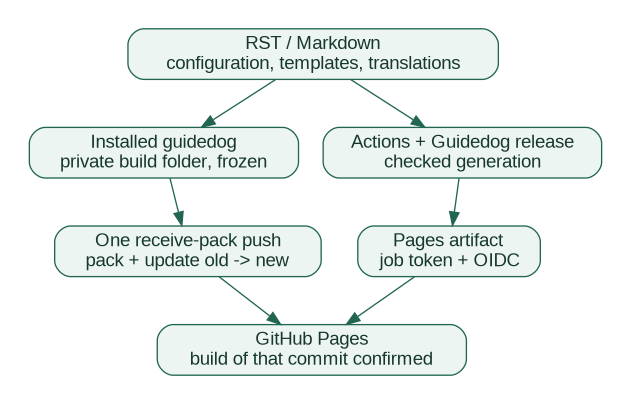
Two publication routes
GitHub’s Pages deployment endpoint requires an Actions-issued oidc_token and an
artifact of the repository. A local token supplies neither. The local route therefore
publishes a branch, and Pages deploys the branch.
| Route | Local publisher | GitHub Actions |
|---|---|---|
| Build | The installed guidedog (or guidedog publish’s own engine) |
A pinned Guidedog release |
| Transfer | One smart-HTTP push of a pack and the branch update | Official Pages artifact action |
| Authorization | A stored token (fine-grained, or device flow) and a machine binding | Job token and Actions OIDC identity |
| Pages source | Dedicated branch, root folder | GitHub Actions |
| Automatic update | guidedog-pages watch, or a machine scheduler |
Push to the chosen source branch |
A repository has one Pages publishing source. publish reads it and refuses a site
deployed by a workflow or from another branch or folder; setup changes it, after
asking. The publisher never silently replaces an Actions configuration.
Programs and libraries
| Part | What it does |
|---|---|
gd-git |
Git object IDs, trees from a list of files, commits, packs (zlib), and the
receive-pack advertisement, request, and report. No networking, no git program.
PackWriter removes an unfinished pack when it is dropped. |
gd-fetch |
send: any HTTP method, headers, a body in memory or streamed from a file,
bounded answers, cancellation, and no redirects (an Authorization header
reaches only the URL it was meant for). HTTP and TLS run in-process (ureq
and rustls), so no curl program, OpenSSL or system certificate store is
needed. |
gd-pages |
The pages publisher of gd-plugins: configuration, credential stores,
bindings, journals, locks, the GitHub client, the device flow, and the
publication itself. It also adds guidedog publish pages (guided) and
guidedog pages workflow to guidedog. |
guidedog-pages |
The command (cmd/guidedog-pages over gd_pages::command); started with
--guidedog-protocol, it serves GDS 0009’s process protocol instead. |
guidedog publish |
Builds with the engine, freezes, and drives the pages publisher, linked in or
registered. |
gd-pages depends on gd-fetch, gd-git, gd-plugins, and gd-toml, and
nothing of the document engine. A publisher is either linked into the guidedog binary
or registered explicitly: guidedog plugin register pages PATH. Neither a project nor
a working directory selects code, and a normal build never starts a publisher.
Credentials stay in the system’s store. On Linux and other Unix desktops the Secret
Service is reached through the secret-tool program with the token on standard input
and output, never on a command line. macOS uses the Keychain and Windows the Credential
Manager through small FFI modules. There is never a plaintext fallback, and Secret
zeroes itself on drop. Settings are plain data (Settings, Roots), so only code,
never the environment, can point a release away from GitHub.
Configuration and binding
pages.toml records non-secret settings; guidedog-pages init writes it.
Unknown settings and invalid values are errors with their line.
schema = 1
repository = "example/project"
branch = "gh-pages"
project = "docs"          # or: site = "build/site"
strict = true
profile = "default"
site_url = "https://example.github.io/project/"
wait_seconds = 300

[watch]
debounce_ms = 1000
max_wait_ms = 10000
Paths are relative to the file. site_url defaults to where GitHub serves the
repository, and is the build’s html_baseurl. profile only names a stored
token; the profile env is never accepted here (see credentials).
A binding, kept in the machine’s state folder (plugins.config_dir()/pages,
readable only by the user), authorizes a profile for one repository, by its GitHub
ID, and one branch, for one account ID. bind creates it after asking. Before it asks, it shows the account,
the repository and its ID, its visibility, the branch’s state, and the Pages
settings. Publication refuses the following, before it moves anything: a target with no
binding; a profile other than the bound one; a token of another account; a repository
whose ID is not the bound one (deleted and made again, or another took its name); a
renamed or transferred repository, including an API redirect; and the repository’s
default branch. A project edit can name a target, but never authorize one.
A branch that holds commits without the publication trailer is someone else’s work.
bind refuses it unless --adopt is given, after which the binding records the
adopted commit and the next publication replaces the branch’s files.
Commands
guidedog-pages init --project=docs --repository=example/project
guidedog-pages auth import --profile=default
guidedog-pages auth login --client-id=APP_ID --scope=public
guidedog-pages auth status
guidedog-pages bind [--adopt] [--yes]
guidedog-pages setup [--yes]
guidedog-pages doctor
guidedog-pages publish [--dry-run] [--wait=SECONDS] [--verbose]
guidedog-pages watch
guidedog-pages status [--operation=COMMIT]
guidedog-pages recover
guidedog-pages unbind
guidedog-pages auth logout
init writes configuration and changes nothing at GitHub. setup points Pages at
the branch’s root, creating the Pages site when there is none. It needs the Pages and
Administration permissions; manual setup in the repository’s settings works too.
GitHub configures Pages only for a branch that exists. So a target without a Pages site
is still published to, and the publication ends Accepted with pages.no-site. Run
setup then. (GitHub turns Pages on by itself when a gh-pages branch first
arrives; the qualification below saw it do so.) setup refuses a branch that does not
exist yet, and says to publish first.
doctor checks the configuration, the builder, the token, the account, the
repository and push permission, the binding, and the Pages source, and writes nothing.
--dry-run builds and reads the target, and writes nothing: no object, no ref, no
setting, no credential.
Credentials
Tokens are stored under the service guidedog-pages with the profile as account: in
the macOS Keychain (Security framework items), the Windows Credential Manager
(generic credentials), or the Secret Service of a Linux desktop (reached through
secret-tool over standard input and output, so the program links no desktop C
library and runs where secret-tool is absent). profiles.toml records
each profile’s account login, ID, method, and date, never the token. A missing or
locked store is a problem naming the store; there is no plaintext fallback.
auth import reads a token from a hidden terminal prompt or from standard input,
never from an argument. auth login runs the device flow. It shows GitHub’s
verification address (only an address on github.com is shown) and code, opens a
browser only with --open, polls at the interval GitHub asks for, slows down on
slow_down, and stops on expiry, denial, or Ctrl+C. Both check the token with
GitHub and refuse to give a profile to another account without --replace.
--scope=public asks an OAuth App for public_repo instead of repo.
GUIDEDOG_PAGES_TOKEN gives a token to one process, never stored. It is used only
when chosen explicitly: --credential=env, or GUIDEDOG_PAGES_CREDENTIAL=env for
runs the command line cannot reach, such as guidedog publish. An unattended run
never starts a device login. auth logout deletes the local token and says how to
revoke it at GitHub; local deletion is not revocation. Token bytes the publisher
owns are cleared when it is done with them; copies a transport library makes are
outside that promise.
| Operation | Fine-grained token / GitHub App | OAuth App token |
|---|---|---|
| Read the account, repository, and branch; push the branch | Metadata: read; Contents: read and write | public_repo (public repositories) or repo |
| Read the Pages settings and builds (confirmation) | Pages: read | repo; without it, publication ends as Accepted |
setup: create or change the Pages source |
Pages: write and Administration: write | repo and the repository’s admin role |
Organization policies (SSO, app approval, rulesets) are reported as GitHub states them: a refused permission names the permission to grant, and a ruleset refusal of the push names the ruleset as the cause.
Publication
A publication runs under the target’s lock, held by one process at a time on the
machine (KEY.lock, a kernel lock); another machine is held off by the compare-and-
swap.
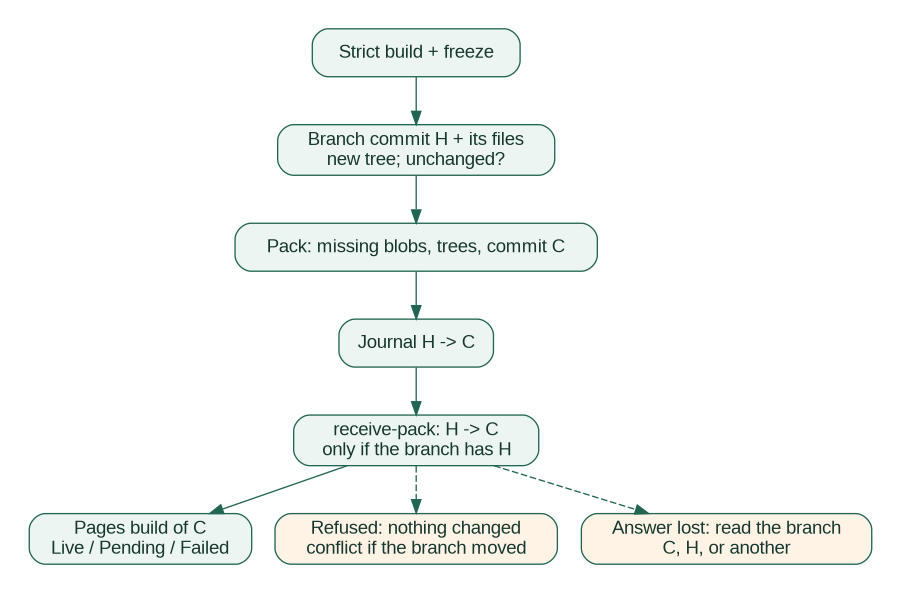
- Build into the target’s private folder (or copy
site), and freeze it: every regular file, path, size, and SHA-256 (GDS 0009’s snapshot). Links, special files, paths Git or a static host cannot serve, case collisions, a missingindex.html, and sites over 1 GiB, 100,000 files, or a file of 100 MiB are refused before anything is sent. - Refuse while a journal of the target is unsettled. Read the Pages source; read
the branch’s commit
Hfrom the receive-pack advertisement; readH’s tree and message, and refuse a commit without the trailer that was not adopted; readH’s files, recursively, with their blob IDs. - Take each file’s Git blob ID, add an empty
.nojekyll(so_staticis served), and build the trees. When the root tree equalsH’s, the target isUnchanged: nothing is written. - Make commit
C: the new tree, parentH, by the account at its privateID+login@users.noreply.github.comaddress, atSOURCE_DATE_EPOCHor now, with the trailerGuidedog-Publication: GENERATION. - Write a pack of the blobs the branch lacks (re-reading and checking each file),
every tree, and
C, then the requestH -> Cforrefs/heads/BRANCH, to the target’s cache folder. - Write the journal (repository and ID, branch,
H,C, generation; no secret). - Send the request. A report of
okis acceptance.ngis refusal, and the journal is dropped: a refusal changes nothing. If the branch no longer hasH, the problem is a conflict: another publication came first. A lost answer is settled by reading the branch again:Cis acceptance,Hmeans nothing was published, anything else is a conflict. When the branch cannot be read, the outcome isUnknownand the journal stays forrecover. - On acceptance, record
Cas the target’s last publication and drop the journal. Poll the Pages builds forCuntilwait_seconds:builtisLive,erroredisFailed(the branch has the site, the previous deployment stays), a queued or running build isPending, and none, or builds the token may not read, leave itAccepted.
The update of the branch is the publication’s boundary. Objects GitHub received for a refused update are unreferenced; readers of the branch see the old tree or the new one. This does not claim that every CDN edge changes at once.
Outcomes
publish, status, and recover end in one of GDS 0009’s states, and exit
with: 0 for Live and Unchanged (and a dry run); 1 for Failed (nothing
published, or the deployment failed); 2 for a usage or configuration problem; 3 when
memory ran out; 4 for files or the network; 6 for Accepted and Pending (the
branch moved, deployment not confirmed: run status later); and 7 for Unknown
(run recover). Problems name their code (pages.conflict, pages.ruleset,
pages.credential, pages.unsettled, …) and the next step. JSON diagnostics
carry no response body, header, or credential.
Watching and recovery
watch is in the foreground and opt-in. It publishes once, then stamps the
source folder (paths, sizes, and times of its files, without build output, caches,
and hidden folders such as .git) every half second, and publishes once the
sources have been quiet for debounce_ms, or max_wait_ms after the first
change. Each round frees what it made, so a long watch does not grow. A failed
build or publication is reported, and the site stays as it was. A refused or missing
token pauses publication without opening a browser. Network failures are retried
after 2, 4, 8, 16, and 32 seconds. Ctrl+C stops it between steps; a push already sent
is settled as above. It watches this machine’s files. Publication after a push to
GitHub belongs to the Actions route. The manual gives launchd, systemd, and Task Scheduler
examples.
recover reads the journal and the branch, and settles as a lost answer is settled.
It never moves the branch back. Without a journal it reports the last publication’s
deployment. A damaged journal is a problem with directions, not a reason to touch the
branch. A future rollback would publish an older tree as a new commit.
Rationale and alternatives
The smart-HTTP push is what git push does, so its limits are Git’s: one request,
compressed objects, and only those the branch lacks. Its update is a true
compare-and-swap, which the Git Database API’s fast-forward check is not. It needs no
git program, no shell, and no credential helper; the token goes in an
Authorization header of two requests to github.com. A future transport must keep
the same transaction and credential contracts.
Building with the installed guidedog keeps one engine and one qualification;
guidedog publish offers the in-process build to those who prefer it.
A private build folder freezes a generation without a lock in the build coordinator;
a copy covers sites built elsewhere.
For teams, the official Actions route offers environment protections, short-lived authorization, and updates on push. A personal token in repository secrets would broaden access unnecessarily.
Security and operational considerations
Project sources, templates, paths, API answers, and remote file names are untrusted input. Answers are bounded before they are parsed (4 MiB, 64 MiB for a tree listing, 16 MiB for Git messages), JSON nesting is limited, duplicate keys are refused, and text from GitHub is escaped before it reaches a terminal. TLS verification is never turned off. Requests that carry a token never follow a redirect. Only GitHub.com is reached, except by a test build. The device flow’s address is shown only when it is GitHub’s.
State files are written beside their place, synced, and renamed over it, with owner-only permissions. Tokens are never written to a file, an argument, a journal, a log, or a crash report. The publisher runs no Python, repository hook, shell command, or Git credential helper.
Publishing a private repository’s site does not make the site private; bind says
so, with the repository’s visibility. The publisher publishes the frozen build output
only, never the repository root.
Backwards compatibility
Guidedog’s existing commands, conf.toml, rendering, catalogs, and templates are
unchanged. Without guidedog-pages or guidedog publish, no GitHub request or
authentication happens. The Actions workflow keeps working. pages.toml, the
state files, and the journal have their own schema versions.
Acceptance criteria and implementation status
Guidedog 0.6.0 ships guidedog-pages in the guidedog archives and the Homebrew
formula, beside guidedog.
| Criterion | Status |
|---|---|
| Explicit ownership, checked bounds, bounded HTTP, cancellation, no Python. | Done. Ownership and bounds are Rust’s; HTTP answers are bounded by
Options::max_bytes and the timeout; builds_run_without_python. |
| A fresh site, a changed site, byte-identical output that writes nothing, removed files, underscore paths. | Done, against a real git receive-pack behind a local GitHub stand-in
(crates/gd-pages/tests/publish.rs); git fsck --strict checks every push. |
| Concurrent writers, a branch of other work, lost answers, journals, failed and pending deployments. | Done in the same tests: conflict, adoption, lost-before and lost-after, recover,
errored, building, and no build. |
| Unbound, renamed, re-created, and default-branch targets; another account. | Done. |
| The same outcomes linked in and through the process protocol. | Done: the guidedog-pages program, driven through gd-plugins, publishes
as the linked publisher does. |
| Device flow: pending, slow down, success; denial, expiry, cancellation. | Done against the stand-in. The release ships no app: an app registered by the maintainers, with its permissions published, is still to be decided. |
| Real Keychain, Credential Manager, and Secret Service. | The Keychain is tested on macOS; Windows qualification requires a real Credential Manager round trip. Linux qualification starts an isolated D-Bus session and GNOME keyring, and requires Secret Service storage and removal. Headless environments still refuse unavailable stores without a plaintext fallback. |
| A real repository on GitHub.com. | Done on 2026-10-13, with a disposable public repository,
insanai/guidedog-pages-check, made for the purpose, and the maintainer’s OAuth token
(repo scope): init, bind, a first publication that made gh-pages
(3.3 s; Accepted, pages.no-site until GitHub enabled Pages), status
Live once the Pages builds API listed that commit as built; a changed page
Live after 28 s of waiting; the same site again Unchanged; a publication
through guidedog publish and the process protocol; one with a token stored in
the macOS Keychain; auth logout. The served site showed each change and
_static/; a clone passed git fsck --strict, with one linear commit per
publication, each with its trailer. A conflict on GitHub itself was not staged;
receive-pack’s refusal is qualified against git. |
| The manual in every maintained language; scheduler examples; release on all five platforms. | The English manual is complete; translations ship with 0.6.0. Release qualification covers the five platforms with an offline smoke test. |
The maintainer accepted the implemented scope on 14 October 2026. The credential adapters are qualified against the native stores. A maintainer-owned device-flow app is a separate deployment decision; importing a token or using an explicit client ID remains supported. See Plugin design acceptance, 14 October 2026.
0.6.1 reliability review
Credential copies remember their allocation owner and are wiped before release. Native-store allocations are checked before crossing C bindings. Local metadata updates hold an exclusive lock across the whole read/replace operation, including separate sessions in one process. Dry runs have separate build folders.
An accepted push remains accepted if saving the local report fails. The journal is
deleted only after that report is durable, so recover can reconcile a lost reply
or local disk error. It never resets the remote branch or repeats a push blindly.
The plugin host now bounds whole requests; a timeout after a possible remote write
reports Unknown and asks for recovery. These are executable regression fixtures.
The manual teaches the native publisher interface using this implementation and the smaller folder publisher. All seven editions share the tested source listings.
Open questions
Who registers and owns the device-flow app, and whether it is a GitHub App (repository selection, fine-grained permissions) or an OAuth App (simpler, broader scopes). The Pages builds API reported the branch deployment in the qualification. Whether it does on every plan, or the deployments API is needed as a second source, is still to be seen. Enterprise Server, custom domains, and forward rollback each need their own qualification.
Review history
2026-10-12: created at the maintainer’s request. The design separates local branch publication from Actions artifacts because the Pages deployment API requires Actions OIDC. The manual gains the currently usable Actions route.
2026-10-13: reviewed and implemented for Guidedog 0.6.0. The review replaced the Git
Database API with one smart-HTTP push (secondary rate limits; a true compare-and-swap),
built with the installed guidedog instead of a linked engine, froze a private build
folder instead of an output lock that does not exist, and made the device-flow app a
build setting. The record now describes the implementation.
2026-10-15: the guided guidedog publish pages and guidedog pages workflow join the
commands, linked into guidedog.
References
- Guidedog: CLI and documentation toolchain, the command line and toolchain.
- Memory budgets and what a build may read, memory and trust boundaries.
- Sphinx-style projects and recoverable publication, local project publication.
- Discussion catalogs for any project, the catalog used to manage this record.
- Native plugin API and registry, the plugin foundation.
- GitHub Pages publishing sources.
- Pages REST API.
- Rate limits for the REST API, secondary limits.
- Git’s HTTP protocol and pack format.
- OAuth device authorization.
- GitHub App user tokens.
- GitHub Pages limits.
docs/manual/howto/github-pages.rst, both routes, step by step.crates/gd-pages,crates/gd-git, andcrates/gd-fetch(linked intocmd/guidedogper GDS 0012).
Lifecycle event
2026-10-12: prediscussion -> discussion. Open the maintainer-requested
publishing plugin design for review
Lifecycle event
2026-10-14: discussion -> accepted. Maintainer requested acceptance after
review of the implemented 0.6.2 scope.
Lifecycle event
2026-10-14: accepted -> committed. Implemented scope reviewed against source
and published qualification.
docs/gds/evidence/plugin-acceptance-20261014.rst; successful 0.6.2 release
run 38434657070.